Showing posts with label family. Show all posts

Friday, March 27, 2020

The Jewish Response to COVID-19

Much has already been said and disseminated about how the Jewish people should be responding to this global calamity. What is the message we are supposed to take from this? What rectification are we meant to enact? What does Hashem want from us?


Obviously, nobody can claim to know the answers to these questions for sure. Fortunately, any teshuva is good teshuva. If you see a message for you in this situation, you should absolutely run with it. Have you been lax in a certain area? (Answer: probably. We all could be doing better in something, right?) Can you work on improving it? If we end up better people as a result of adversity then we are on the right track.

This is of course somewhat less satisfying than having a clear sense of what the message is. This is one of the drawbacks of being without prophets. In our era, we are probably not going to be able to know with certainty what Ratzon Hashem is. I’ve seen and heard a number of attempts at explaining what we are supposed to learn from this situation.

Did we not take tefillah b’tzibur seriously enough, so now it’s been taken away?

Were we not careful enough with the kavod of others, so now we’ve been separated from them?

Was there too much sinas chinam, so now we’ve been isolated?

Did we neglect our family relationships, so now they’re the only ones we can interact with?

Did we fall prey to our taavahs, and therefore we’ve been forced to cease contact with other people?

These are all possible explanations. And the concomitant remedies are all well worth our time. Yes, we should work on our davening. Yes, we have to do better in our bein adam l’chaveiro. Yes, we should put more time and effort into our spouses and children. Yes, we should ramp up our levels of kedusha. Any teshuva is good teshuva. Don’t waste the opportunity!


I do think we have to be careful, however, about some of the peripheral interventions that have been suggested for these failings – segulos, extra tefilos, kabbalistic rituals. I am not by any means suggesting these are not authentic Jewish responses in a time like this. Bigger and wiser rabbis than me have made such suggestions, and I don't mean to disagree with them. However, it is important not to put the cart before the horse.

Saying ketores in the morning is valuable and has a solid basis in mesorah. Reciting extra Tehillim equally so. BUT: these should not be done at the expense of the fundamentals! Namely, if you are pressured for time (and who isn’t these days?), and spending an extra five minutes praying is going to add to your stress level, which will come out on the heads of your family members, it’s not worth it. I think any of the gedolim who have suggested taking on special tefilos or practices would agree with this - not at the expense of the basics of Jewish belief and behavior.

If you can add more tefilah to your day without it negatively impacting your family, go for it. But if you cannot – and that is totally reasonable in this reality – then you don’t need to try. Moreover, you cannot say ketores and tell yourself you're doing the right thing if you're at the same time being nasty at home or cutting ethical corners at work.

I am hesitant to sound like I am contradicting our spiritual leaders. But if I may humbly suggest, I think for many of us (and I include myself in this), focusing and reinforcing the basis is where the focus needs to be as we try to make it through this incredibly challenging time. (And if you have time and energy for extras, more power to you!)
  • Remember to daven every day (meaning, for men three times a day and for women whatever you have been accustomed to doing). With schedules upended it’s all too easy to miss one.
  • Stay away from inappropriate materials on the internet (including indecent websites and those that peddle in lashon hara).
  • Shalom bayis keneged kulam. Put all your extra energy into keeping your cool, being nice to your spouse and children, and modeling for your children how you would like them to behave under stress.
This last point bears further elaboration, because I think it might actually be the most important. If you miss mincha because you are overloaded managing work and kids, there is tashlumin for that. There is no tashlumin for losing your temper because your 3-year-old spilled her yogurt.

Make sure to take some to yourself, even a few minutes a day, to let yourself cool down. If you’re walking around all day on the edge of losing your temper, you’re bound to explode at some point. Recognize that this is an exceptional time in many regards, and your life will not operate like clockwork right now. Accept the imperfectness of the situation.
If you are being nice to your family, davening regularly, and maybe even keeping some semblance of a regular learning seder, you are a hero. You don’t need to fast or say ketores to be doing Hashem’s will here. Those are fine things to take on if you can. But be realistic about what you can and what you can’t take on. Don’t say ketores then go yell at your kids for disturbing you during ketores. One moment of anger can erase all the spiritual benefits of a good psalm reading.

Focus on the cake, and add the icing only afterwards. If you can keep putting one foot in front of the other during these challenging times, if you can meet your basic halachic requirements and display good middos at the same time, then you are doing Ratzon Hashem.


Thursday, March 29, 2018

Freedom for Our Children and Our Children's Children


“If the Holy One, blessed be He, had not taken our ancestors from Egypt, behold we and our children and our children's children would [all still] be enslaved to Pharaoh in Egypt.”

This text from the Haggadah begs the famous question, “Really?” That is to say, ancient Egypt is long defunct.  Had we really not been taken out by G-d at that time, probably we would have eventually gotten out of that jam when Egypt was conquered by the next up-and-coming world power. So what is the Haggadah talking about here? The famous answer is that we are not talking about physical freedom, but about spiritual freedom, which, after all, is what Judaism is all about.  Had we not been saved from Egypt, we would have completely assimilated and lost our Jewish identities, our Jewish selves, our Jewish missions. 

The impact of the environments we live in and of our surrounding cultures cannot be taken lightly.  Though we were nearly lost in Egypt, Jews have remained Jews through the worst physical persecutions.  Jewish identity in America today is more threatened than it was for centuries in Poland under oppressive regimes and crushing poverty, until the Enlightenment opened up new avenues for Jews into European society and assimilation began en masse.

Modern Western culture may share more with ancient Egypt, however, than with the Europe of recent history. The linguistic root of the word “Pharaoh” in Hebrew means “wild, let loose, shameless.” When we say we would still be slaves to Pharaoh, we indeed mean a spiritual slavery, a slavery of our soul to our baser instincts. One can be free to move about as he pleases and still be acting more out of compulsion than contemplation.  If you aren’t sure how to understand this idea, ask someone who’s addicted to drugs, or alcohol, or better yet, internet pornography – they’ll tell you what it’s like to be enslaved to the power of desire.

Our society today aggressively pushes a life of the body over the mind, let alone the soul.  Our girls are taught that their only value is in the shape of their physique, and that only one kind of shape is acceptable.  They are sexualized at younger and younger ages and are being taught how to flaunt that sexuality front and center, rather than channel it for meaningful ends.  Meanwhile, our boys continue to learn that their greatest worth comes from the conquest of women, and society continues to give them a “presidential pardon” when they engage in such conquest by force or coercion.  They are stars when they are celebrities and athletes, and are thus given a pass on all kinds of ignoble behaviors.

This is nothing you don’t already know. But have you stopped to think lately about how you too are a part of this shamelessness? How society has dragged you just a little bit further in than you’d like or care to admit?  Here’s one way I’ve discovered in which I am part of the problem rather than the solution.  Like most everyone else, when I come home to find my daughters dressed for Shabbos, or ready for a wedding, or wearing an outfit I haven’t seen before, what’s the first thing I say? “Ohhh, beautiful! You look so pretty!”  Don’t we all, upon visiting our friends and siblings, greet their daughters by commenting on how nice they look?

Granted, it is a little awkward to suggest opening up with “Ohhh, you are clearly very diligent and analytical!” First impressions inherently do not lend themselves to seeing beneath the surface.  But that doesn’t mean that focusing on the surface is a wise alternative.  If the first thing your children hear from you concerns their appearance, what are they to assume is your priority? Worse, what if you never do comment on their qualities of character or intelligence?

So I’m going to aim for a change. I’m done with being a part of enslaving my girls to the tyranny of cultural pressures.  I want my children to grow up knowing that the most valuable part of themselves is not how they look (and even less how others think they look), that freedom is more about choosing the right values and not the right shoes, and that ultimately their bodies are not what is most valuable about them, but rather merely a vessel to express that which is.


Postscript: Admittedly, alternatives to commenting on our children’s cuteness aren’t so easy to come up with.  Here are some of my ideas. Would love to hear some ideas from you in the comments!
  • “It’s so nice you see you!”
  • “That is a very creative hairdo!”
  • “You look all ready for Shabbos!”
  • “I see you’ve been a big helper by getting yourself dressed!”


Tuesday, May 3, 2016

Amudim

Apparently there's a new Jewish organization on the child sexual abuse prevention scene, Amudim.  I don't know much about them, but I just saw this video they produced, which is extremely disturbing and emotionally jarring.  It warns that the video is graphic, which is not entirely accurate - but it is definitely triggering for anyone who might have trauma in their past, so please consider whether you want to watch this or not.


Sunday, January 24, 2016

The Best Gift for Your Children

I've recently been thinking about the adage familiar to many marriage counselors that "The best gift you can give your children is shalom bayis."  There are many reasons this is true - it is neither some crazy therapist thing nor a mystical idea.  Check out a quick run-down I wrote for Aish.com here, or a longer series of posts at my Baltimore Therapy Center blog, starting here.

Saturday, February 28, 2015

The Very Special Gift

Dear Readers,

I am most pleased to announce the publication of my latest book, The Very Special Gift.  It is designed to help parents educate and discuss with their daughters the issue of tznius.  It is targeted to early grade-school-age girls, but it probably has a good degree of flexibility in terms of getting the message across.  I hope that this will be helpful to many people in addressing this vital and challenging subject with your daughters.


If you buy a copy, please do let me know what you think in the comments below!

Wednesday, November 19, 2014

How to Argue with Your Spouse Without Solving Anything

An article I wrote about spousal disagreements has been posted on wellness.com:
argumentArguments among dating and married couples have gotten a bad name. Sure, they cause anger, frustration, tears, breakups, and divorces, but apart from that, who doesn’t enjoy a good yell at their partner from time to time?
https://www.wellness.com/blog/13270621/how-to-argue-with-your-spouse-without-solving-anything/raffi-bilek

Saturday, November 8, 2014

How to Be Married to a Woman

The sequel to my highly popular "How to Be Married to a Man:"

How to Be Married to a Woman

My article, “How to Be Married to a Man,” recently published in the Where What When, earned me a lot of head nods and a couple of high-fives from male readers. It also led some women to indicate that perhaps I could offer some comparable tips to the other gender. (That would be the male gender. I am spelling that out for the men, who, of course, need things made explicit for them, because they don’t do things like “infer” from what you said.) In recognition of the great need, I present you with this article about how to be married to a woman. And this time, I can claim a lot more credibility, since I (a man) am married to a woman.

I will break down the essence into a triplet that I did not invent but that has been used widely by many other folks and is pretty darn helpful: It’s all about the three A’s: affection, attention, appreciation.

Affection: Men are classically bad at this function. There is a story told in many forms – here is one of them – about a man whose miserable wife schlepped him to a marriage counselor to try to get him to be more expressive about his feelings for her. She felt unloved and unwanted. For his part, the man couldn’t understand what the problem was: “I made a promise to my wife on our wedding day, and I intend to keep it,” he explained to the therapist. “Oh?” inquired the wisely taciturn counselor. His male client elaborated: “Yes indeed. I told her that very day that I loved her, and I promised her that if anything changed she’d be the first to know.”

Ha ha, right, gentlemen? It is unfortunately not so funny, insofar as many of us practice this approach to some degree. For most men, hearing “I love you” on a daily basis is not nearly as emotionally nourishing as, say, a hot steak dinner (see previous article). For many women, however, the “I love you” beats the steak hands-down any day. Men, wise up. You need to tell your wife that you love her (and mean it). Regularly. Yes, I know you’re not comfortable expressing your feelings like that. Well, guess what? I’m not so comfortable taking out the stinky garbage, but I do it anyway. Regularly.

Let’s be clear here: it’s not that your wife forgets that you love her. It’s just that she likes to hear it, over and over. She likes frequent refills. Here’s an example: Smart husbands bring their wives flowers for Shabbos, Yom Tov, and other occasions. Now, to you and me, it just doesn’t make sense. The flowers will absolutely, definitely be dead well before your next oil change is due. Wouldn’t it be so much more sensible to give her a nice potted plant that would last longer? Go ahead, try that; next Friday, bring a home a hefty Boston Fern and see how that goes over. Unless your wife is particularly horticultural, I’m guessing it will score you exactly zero points. Why? Because women do not go for one giant dose of affection, off of which they are supposed to survive for an extended period, like some kind of love camel. Women want small tokens of love over a long time. Hence flowers are the right choice because they are ephemeral. She sees that you are thinking of her and expending money on her – even just a few dollars – on a weekly basis. And hence, too, the “I love you” statements have to keep coming. But because women, despite my grandiose generalizations, are in fact individuals, you need to discover exactly what brand of affection-on-a-regular-basis your wife is seeking, whether it’s verbal affirmations, flowers, hugs, or what have you. (Bonus tip: why don’t you ask her?)

Just as you cannot buy a large gift and hope that it will cover you for the next year or decade, you can’t spend a day with your wife and then ignore her for the rest of the week. Your wife wants your attention. This means putting your focus exclusively on her on a regular basis (there’s that word “regular” again) to whatever extent is realistic for the schedule on which your life operates. For some people, that might come down to just a few minutes a day – but as with the flowers, it is the fact that it keeps coming back that shows that it’s real. Otherwise it can feel like you’re buying her off with a lump sum rather than taking the trouble to keep recurrent transactions going. Conversely, small deposits of time over many occasions indicate that you actually want to spend that time with her. (Note that the Rambam states that it’s better to give a dollar a day than $365 once a year. It is a different quality of giving.)

Indeed, attention takes place even when you’re not actually with her. Remembering to buy flowers when you’re out is not only a nice sign of love and affection, it also shows her that you think of her from time to time – that she “takes up space in your hard drive,” in the words of a respected rav. So does bringing her back her favorite pastry from the bakery you passed by or even picking up her preferred brand of contact solution because you knew she was running low. These things all demonstrate that she is important to you and that you are thinking of her.
Attention also means listening to her chat about her day rather than checking your email/the news/the score on your iPhone during dinner or in the car or while you are cleaning up together. (Hey, now there’s a good idea.) Hopefully, most of the time, what she has to share is not dire or urgent, but you still have to listen. More than that, you have to attend. Registering sound waves on your eardrums while actually attending to the smartphone does not count, because your attention is on the smartphone and not the wife. It does not convey to the wife that she is important to you, even if you did hear what she was saying and can repeat it back to her in some exaggerated attempt to prove you were listening. When you listen to her about the small things as well as the big things, you show her that what is going on inside her is important to you – that she is important to you. That’s what she wants and needs from you.

Appreciation: We men are frequently the main providers in our households. We go out to work eight-plus hours a day, sometimes slogging through a grueling commute, and coming home in the evening to our wives who perhaps do not work, or work less than us, or work at less intense jobs than we do. Consequently, we often come to the extremely boneheaded conclusion that we are working harder than they are. Let’s be clear about this: if you have children, your wife is probably working much harder than you are, even if she is a stay-at-home-mom. And if she is even minimally employed on top of that, it’s a pretty sure bet.

Some of our male readers are right now nodding their heads in agreement. Those would be the men who have had to manage the household for any period of time while their wife has been away or ill, and who have experienced what it is like to try to get the kids in the bath while cleaning up from dinner and packing up the lunch boxes, and the baby is crying and probably needs a diaper change except that you can’t remember where the diapers are, and once you find them you end up putting it on backwards anyway, and nobody will brush their teeth because you didn’t put the toothpaste on the right way. And so on.

Needless to say, I have a tremendous amount of respect for my wife.

What is needed, however, is that I say it. That is, I tell my wife – once again, regularly and frequently – how much I appreciate what she does. The truth is that it’s remarkably easy, because I know what my life would be like if she didn’t do what she does. If she did not cook me dinner, odds are I would be eating a whole lot of toast and tuna fish. So I appreciate when she cooks me dinner. I appreciate it, out loud, every single time, because that’s one more night I’m not eating toast for dinner. (Sometimes if she doesn’t cook, I might be eating leftovers, but of course that also means that she made me food the night before.) I appreciate when she puts the kids to bed, because if she didn’t, I would be going bonkers trying to pull it off with half as much patience as she does. If you think about it for not very long, I am sure you can come up with a similar, extensive list of deeds your wife does for you. You are not entitled to these favors. Nowhere did she sign a contract stating that she will cook your meals or do your laundry. We must be super grateful for all the things our wives do for us all the time that we often hardly notice; we must say so to them, and we must mean it. It means an awful lot to your wife when you sincerely thank her for dinner, even – especially – when it wasn’t a five-course holiday meal. Try it and see.

Dear readers: although this article is (intentionally) humorous, it is also filled with very real and helpful advice. My advice is, take my advice. As with my previous article, this is by no means a complete list of what it takes to make your wife happy. (Thought you could get away with three things, eh?) But these principles are a good foundation: Start with these, but don’t stop with them.

Saturday, November 1, 2014

Getting Your Kids to Eat Their Dinner

Here is another column from the BJH in which I answer the classic question: How do I get my kids to eat their dinner???


Dear BJH,

My kids are really great overall, but the one area that never seems to work out is dinnertime.  They simply don’t want to eat!  It always seems to be a fight getting some food into them.  How can I get them to eat their dinner properly?

Thanks,

GS


Dinnertime is a common flashpoint between parents and kids.  You are not alone!  Let’s take a look at some conceptual points that will help us develop a healthy approach to dinnertime, and then we’ll touch on some practical tips to grease the wheels.

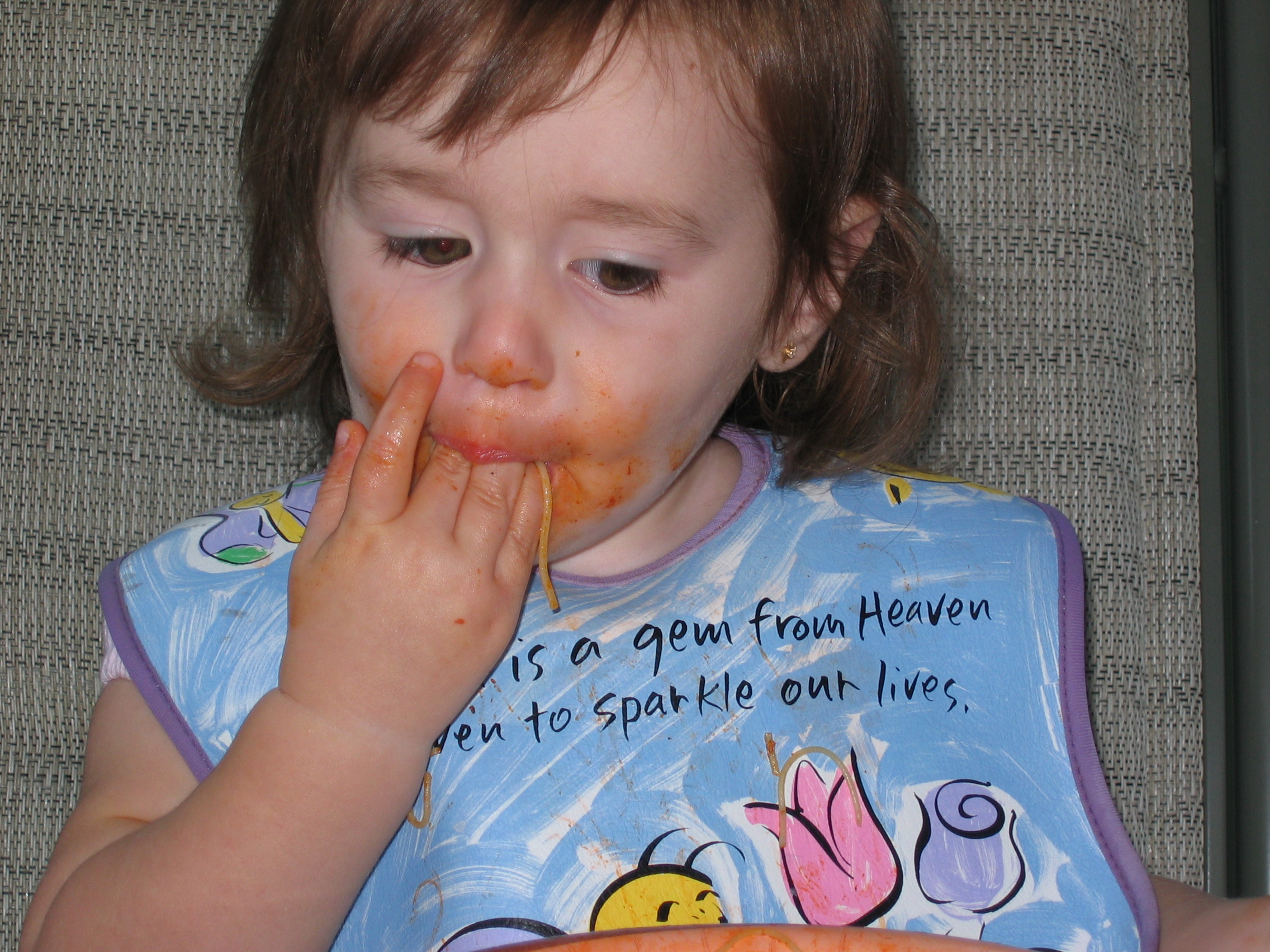
child eating dinnerThe cardinal rule of handling your children’s eating habits is not to make it a power struggle.  If you really really want your kids to eat, and they know it and feel it, they are likely to take the opportunity to assert their independence, as children are wont to do – especially if they are already feeling too controlled or micromanaged at home.  This is normal behavior for a child, not a behavior problem!  The more you try to compel your child to eat, the more resistance you are liable to face.  (This is evident in the classic “Try it – how do you know you don’t like it if you haven’t tried it?” debate.  Have you ever seen a kid finally give in and then say, “Hey, you know what Dad, you’re right!  This is really tasty!”  No, you have not.)

The solution is to not care if they eat. Really.  If you are genuinely concerned about their nutritional levels, take them to the doctor and get a blood test.  If the doctor says your child is healthy, then there is no problem with their food intake.  If they aren’t hungry for dinner, then they aren’t hungry.  (Do you often eat a meal when you aren’t hungry?  Probably not.)  However: you can and should nonetheless establish rules so that they do not drive you crazy later on in the evening.  That means that dinner should be available for a defined period, not whenever they feel like eating.  If they discover that they are in fact hungry just before bedtime, let them have a piece of bread or matzah – something really plain that will sate their hunger.

What happens when you give up your need for them to eat is one of two things: either they stop feeling the need to resist and start eating, or they continue not to eat because they really aren’t hungry.  Fortunately, nature works in your favor on this one, and eventually, they will be hungry enough to eat (trust me on this one). If you keep junk food out of the house as much as possible (or at least inaccessible), and model healthy eating yourself, then when the cravings strike your children will start eating nutritional foods, which keeps you, them, and the doctor happy.

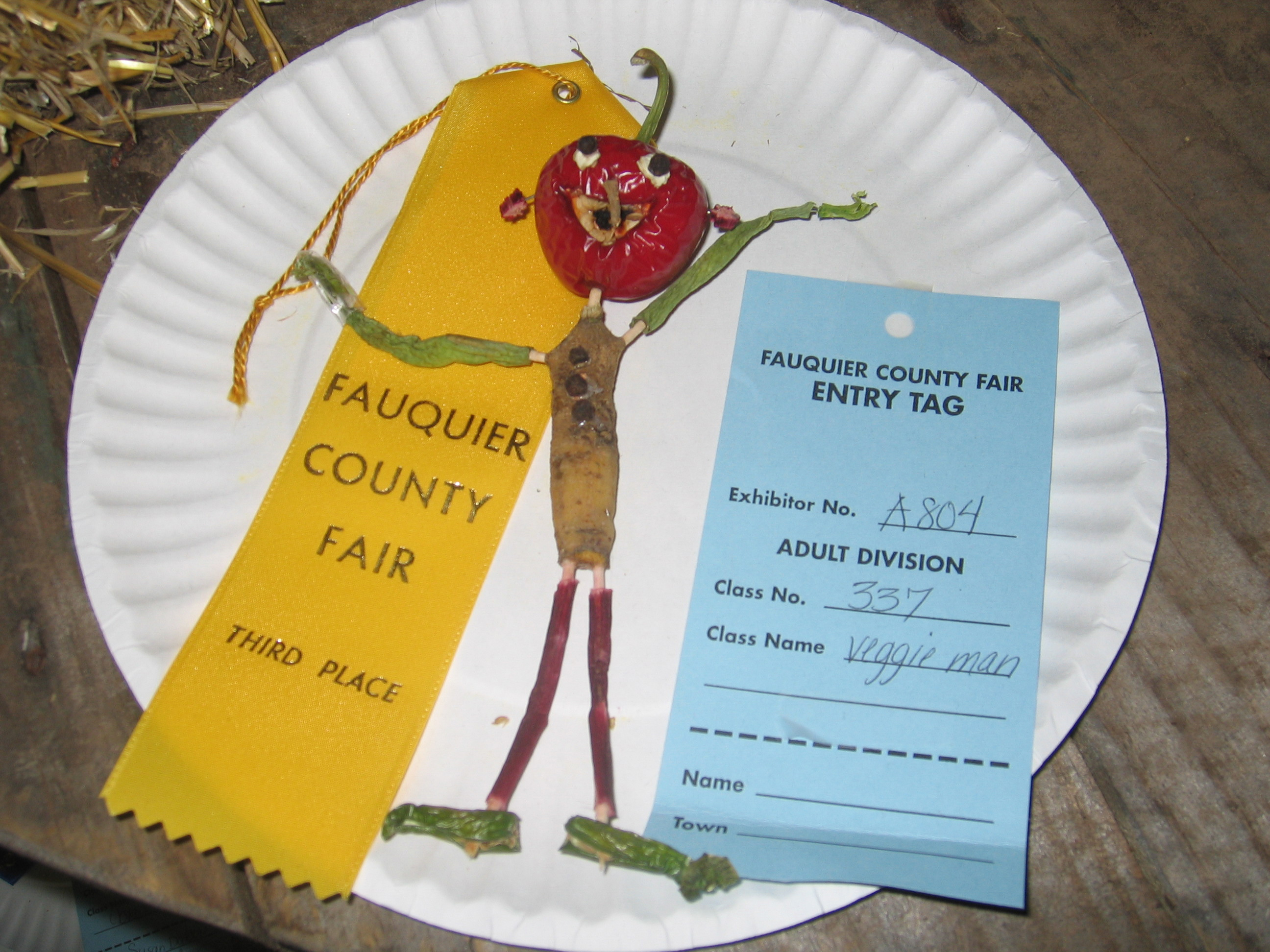
Vegetable ManFinally, some practical points to bear in mind to help ease the situation for fussy eaters and such: first of all, make sure your kids like the food you serve.  This may be obvious, but we sometimes forget that kids in general like simple, whereas we older folks enjoy more complex flavors. Complex doesn’t do it for kids.  They want plain noodles, or maybe noodles with cheese.  A bowl of cottage cheese could be great, with a cucumber stick on the side.  If you are making delicious casseroles for you and your spouse, you may need to be making backup foods for the kids as well.  And yes, they may want to eat the same thing every single day.  Don’t force them not to!  It seems unpalatable to us, but as long as the doc says the kids are healthy, there is absolutely nothing wrong with it.  Their bodies will provide cravings for the right balance – carbs, proteins, etc. – over time (provided that their systems are not awash in sugar).

Lastly, make it fun.  A young child who refused to east his or her veggies moments ago might do a complete 180 once s/he sees the little man with funny hair that you created out of carrots and cukes. Some children like to pretend they are eating fantastic items (magic beans, anyone?) or that they themselves are animals of some kind while they eat. Older children may enjoy being a part of the preparation process.  Creativity is key.


This is not an exhaustive list of ways to better manage dinnertime, but I hope it will spark some ideas for you.  Most importantly, keep in mind the pitfall of the power struggle.  When you let go of your need for the children to behave in a certain way – and this is true in many areas – you may find that they will step up to the responsibility quite on their own.

Saturday, October 18, 2014

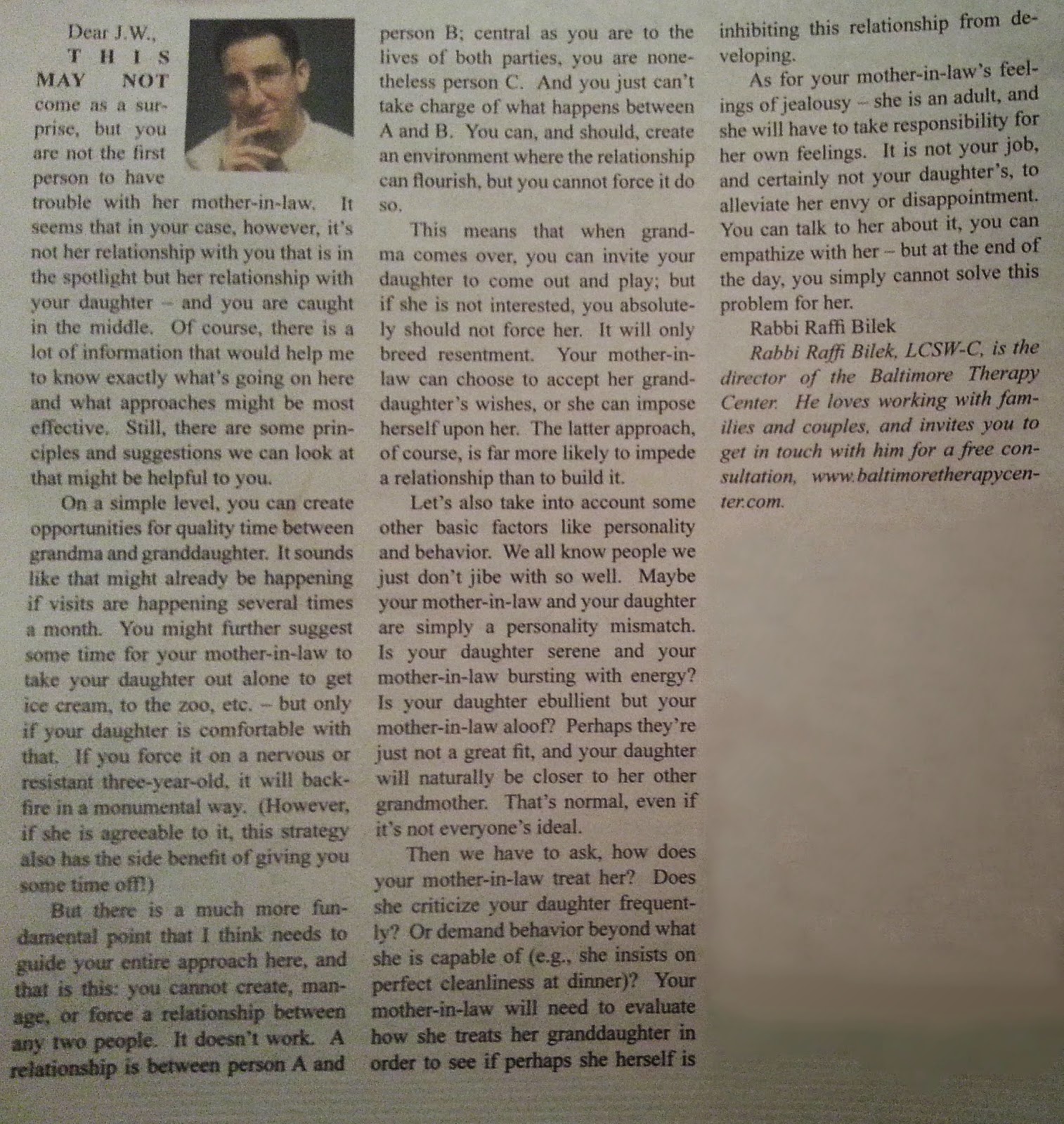
New Article in the Baltimore Jewish Home

One of the kinds of issues I am frequently called upon to help with involves relationships among parents/in-laws/grandparents.  Here is a column I wrote recently in the Baltimore Jewish Home addressing such an issue.  This doesn't necessarily sound like a candidate for family therapy, but it could certainly help.  These situations can be thorny, no doubt about it.


Thursday, September 18, 2014

Positive parenting won't make up for yelling, insulting

I thought this was a powerful article about effect we as parents have on our children.  Check it out:

Young adults who had been criticized, insulted or threatened by a parent growing up were more likely to be anxious or depressed, in a new study.

Even when the same or another parent expressed plenty of affection, researchers found the apparent harmful effects of having a verbally aggressive mother or father persisted   . . .
http://news.yahoo.com/positive-parenting-wont-yelling-insulting-212707632.html

Thursday, August 28, 2014

Kids hear EVERYTHING

Recently, I was sitting at dinner with my wife and kids and discussing the mundane issues of daily life.  At one point my wife mentioned to me something about putting the kids in camp for an extra few days. My six-year-old daughter piped up and cheerfully asked, “Because you don’t want to deal with the kids, right?”

I felt a little bit like dirt.

That is really not how I want my kids to think we look at them.  We so easily overlook how perceptive our kids are from the youngest ages, and how they pick up everything we say, whether we think they are listening or not.  No doubt we have used the phrase “dealing with the kids” numerous times before – look, there’s no question, they can be tough to manage.  They take a ton of energy – not just physically but mentally and emotionally as well.  They suck up time like a miniature screaming snot-nosed black hole.  But we should not be talking about our kids, or even thinking about them, as something we have to “deal with.”  We love them.  We admire them.  We cherish them.  We educate them.  But we do not “deal with” them.  We pour our energies into them with a deep sense of greater purpose as we trying our hardest to build competent, capable, balanced human beings.  It is a privilege and a responsibility.  It is not a chore or a punishment.

You will note here that I am speaking primarily to myself.

But let’s all try to remember it despite the tribulations of childrearing.  And let’s also remember that whatever attitude we choose, our kids will know it.  How do you want your kids to feel growing up? Like a chore?  Or like a precious diamond?  You have a sizeable influence on which way it’s going to go.

Thursday, August 14, 2014

Not Your Average Advice Column Response

This provides a little levity in the family therapy field (check out Amy's response). At the same time, it's a bit sad. (This is just the kind of case I help with, if you find yourself in a similar situation...)
Dear Amy: Every fall, my sister, cousins and a cousin’s sister-in-law have a weekend shopping excursion in our home city. We stay in a hotel, treat ourselves, shop for our children and go out for lunches and dinners. It is a great time to reconnect.
I have a sister “Wendy,” who we do not invite. She is offended to the point of tears when she finds we have not invited her...
http://amydickinson.com/post/85115023030/sisterly-exclusion-makes-one-sis-a-horrible-person