Showing posts with label relationships. Show all posts

Sunday, January 21, 2018

The Five Love Languages and G-d

There is a parable of a king who sent two of his servants to fetch him a drink of water.  The first servant ran out to the royal grounds to the nearest well, drew a bucket of water, carried the bucket to the kitchen and poured off a glass of water. Panting and sweating, he then brought the glass of water as quickly as he could to the king, who smiled and thanked him before drinking it down.  The second servant likewise ran off, but as he was going, he began to deliberate.  “I am not the strongest servant the king has,” he reasoned, “surely he is not expecting me to haul a heavy bucket of water for him.  I am much more talented as an artist than a transporter. I will draw the king of beautiful picture of a glass of water. This is a much better way for me to serve the king!”  And so he did. When he brought his drawing to the king, the king was disconcerted.  “It certainly is a nice drawing – but I asked for water to drink. I can’t drink this.  It’s not what I asked for.”  The king was not happy, and the servant did not end up feeling like he had properly served the king.

This parable reflects the traditional Orthodox outlook that G-d is to be served in the way He has requested and not in the way we feel suits us best.  Drum circles and freedom seders are fine ideas, but they aren’t what G-d asked for.  G-d has made clear what he asks of us in the Torah: He has provided us with numerous ways to connect to Him and thereby to build a relationship with our Creator.  There is much room for individual expression, but not infinite room: if we want a relationship with G-d, there are avenues that will lead us there and there are avenues that will not.

This idea helps provide the answer to a question recently asked of me by one of the partners in a couple I was treating.  In working on their relationship, we drew from the theory of the Five Love Languages, which posits that there are five basic “languages” in which people communicate love. (These are Words of Affirmation, Quality Time, Acts of Service, Gifts, and Physical Touch, although the details don’t concern us right now. You can read more about these in detail at my professional blog.)  For the most part, every person responds best to one of these languages and feel most loved and cared for when their partner communicates their love in such fashion.  If someone’s Love Language is Physical Touch, a nice present might be appreciated, but it won’t fill them with a feeling of being loved the way holding hands would.  For someone whose language is Acts of Service, having their partner mow the lawn or do the laundry can be a far more romantic gesture than the most eloquent verbal expressions of love.

The question I was asked in session was, “why do I have to learn her Love Language?  Why can’t I tell her I love her the way that works for me and she can get used to the way I do it?” One could answer this question in many ways, but I started by simply pointing to our relationship with G-d. If you want someone (or Someone) to accept your overtures for a relationship, it has to be done on that person’s terms and not yours.  I told this client that I surmised he may like beer a whole lot, but he probably gave his wife flowers when he first met her and not a Heineken.

Learning to relate to someone else means learning their language, their interests, their preferences, their inner selves. It means engaging with them on their terms and not yours.  “Therefore shall a man leave his father and his mother” – the customs and norms he grew up with – “and cleave to his wife.”  Trying to impose upon your spouse your own ways of doing things and expecting them to respond as you would is obviously rather egotistical.  You can’t make a person feel loved using the methods that make you feel loved any more than you can satisfy the king’s thirst with a drawing of a glass of water.


Having a relationship means “if it’s important to you, it’s important to me.”  Being willing to learn what is important to your spouse and what makes them feel loved is the necessary first step; you can’t assume that what moves you will impact your partner in the same way.  Step two is to do it. Becoming adept at and comfortable with your spouse’s Love Language is in fact the work of many years, not just a flash of insight.  But this is, after all, the work of every relationship, whether we call that relationship marriage or avodas Hashem: changing ourselves to comport with the needs of our beloved.  It may be a laborious task, but is a labor of love, and it brings with it the profound satisfaction that only our deepest relationships can offer.

Thursday, February 2, 2017

When Your Spouse Has a Mental Illness

I recently contributed to the growing Refuat HaNefesh blog, a site dedicated to destigmatizing mental illness in the Jewish world and educating people about it. I lent some insight about my expertise, marriage and relationships, to this particular topic.  Check it out here.

Tuesday, March 29, 2016

The 36 Shailas That Lead to Love

shidduchim helpI just came across the following article in the NY Times from last year about “The 36 Questions That Lead to Love” and I thought it had a lot of applicability to shidduchim.  In it the author cites another article called “To Fall in Love With Anyone, Do This,” which is also very relevant in that it affirms that love is not something we have to resign ourselves to “falling in” but rather it’s something we can purposefully create.  This is an important antidote to the media’s incessant portrayal of “love at first sight” and romance as the highest ideal.
 
So the 36 Questions That Lead to Love comprise a list of questions that become increasingly intimate (by which I do not mean graphic or inappropriate).  They were created as a part of an experiment to see if love can be invented instead of discovered, the idea being that the more you let someone into your self, the more connected you will feel.  For those of who you are unsure what to do on an actual shidduch date or what to talk about, this list is a handy reference. 
 
Obviously, you should start at the top of the list and work your way down – slowly.  One does not on the first date open up question #29 (“Share with your partner an embarrassing moment in your life”).  But it might very well be something appropriate a few weeks into things. It does take some judgment.
 
Fortunately, the start questions are really great for learning about each other in a very non-threatening way.  “Given the choice of anyone in the world, whom would you want as a dinner guest?” is a great conversation starter!  (If this exercise yields one-word answers and no more – “Rambam.” “Oh.” – then one or both of you are doing something wrong.)
 
I found the list very intriguing and can imagine many hours of discussion arising from these. Maybe you will as well.

Monday, May 18, 2015

Growing as a Couple

My friend and colleague Ariel Schochet wrote a nice post about couples counseling on his blog, entitled Peer Pressure in the Therapeutic Environment. I am a big fan of the approach he is advocating, which is to avoid the "keeping score" trap and to just give your marriage your all.  Some people have expressed this as eschewing a 50%-50% balance and conceiving of it as a 100%-100% balance - i.e., I don't count how many times you do for me, and you don't count how many times I do for you - we both just do for each other what we can (i.e., don't overextend yourself), all the time.  Check out his post here.


Ariel Schochet, LPC, NCC, is the managing partner of The River Wellness Group, located in Passaic, NJ and Teaneck, NJ.  They are a full-service counseling practice, whose range of services include child, adult, couples, families and addiction psychotherapy services.  To learn more about The River Wellness Group, visit www.riverwellnessgroup.com.

Thursday, April 30, 2015

The Circumcision of Desire

Rabbi Sacks recently wrote a piece centering on circumcision that I think also has value for the discussion of domestic violence and the power and control issues that are at the heart of it. Check it out here.


. . . Brit milah helps transform the male from Baal to Ish, from dominant partner to loving husband, just as God tells Hosea that this is what He seeks in His relationship with the people of the covenant. Circumcision turns biology into spirituality. The instinctive male urge to reproduce becomes instead a covenantal act of partnership and mutual affirmation. It was thus as decisive a turn in human civilisation as Abrahamic monotheism itself. Both are about abandoning power as the basis of relationship . . .

Sunday, December 28, 2014

How to Complain

Another important note about checking in with your mate before letting it all out:


Sunday, November 30, 2014

Do You Need Couples Counseling?

Are you in need of couples counseling?  How would you even know whether you are or not?  Here are some questions you can ask yourself to determine whether you are a candidate for marriage counseling:

    Couples Counseling
  • Is your marriage/relationship more often negative than positive?
  • Do you feel indifferent towards your spouse/significant other, or sense that s/he feels indifferent to you?
  • Are you looking for something different from your relationship but can’t even define what?
  • Do you find yourself dreading being with your spouse/significant other on a regular basis?
  • Has your spouse/significant other cheated on you?
  • Do you frequently wonder whether your marriage/relationship is going to make it?

While this is by no means an exhaustive list, a “yes” answer to any of these questions is a good indication that it might be time to seek the help of a couples counselor.  Marital therapy can do a lot for a couple, whether the relationship is really on the brink or is just has a few rough spots that need smoothing out.  The intervention of a trained and objective professional can make a big difference.

Your couples counselor can help you get down to the root of what the problem in your relationship really is.  Often a couple will come into the therapy room with complaints about issues that are really don’t get at the heart of the trouble – like how to squeeze the toothpaste, or what one person or the other said last night.  In truth the issue likely runs much deeper, and a marriage therapist can help discover what that is.

Another important way the relationship counselor can help is to teach a couple to communicate about a problem more effectively.  Frequently when there are important values at stake people can get very emotional.  When couples come to counseling and there is already a lot of anger, hurt, and resentment, it is hard for them to speak productively, i.e., without hurling insults and accusations. A competent couples therapist will see to it that a conversation can happen in which the couple can move beyond this level and actually get to discuss and resolve the issues at hand.

Finally, a marriage counselor can offer guidance on how to go forward in the relationship. While it is not the counselor’s place to suggest to a couple that they should or should not break up, the counselor can propose ideas of what kind of things would help a couple make that decision for themselves, and what kind of behaviors might make the result they decide on more or less likely.

Of course, couple counseling is an intense process that cannot be boiled down to a few bulletpoints; nonetheless, this brief outline will hopefully help you think more clearly about whether it’s time for you to seek relationship counseling and what you might get out of it.

If you are thinking about couples counseling or marital therapy, please contact me to find out how I can help you.

Wednesday, November 19, 2014

How to Argue with Your Spouse Without Solving Anything

An article I wrote about spousal disagreements has been posted on wellness.com:
argumentArguments among dating and married couples have gotten a bad name. Sure, they cause anger, frustration, tears, breakups, and divorces, but apart from that, who doesn’t enjoy a good yell at their partner from time to time?
https://www.wellness.com/blog/13270621/how-to-argue-with-your-spouse-without-solving-anything/raffi-bilek

Thursday, November 13, 2014

Can I Make a Suggestion?

This is an important question to ask... if you're planning on listening to the answer.

Saturday, November 8, 2014

How to Be Married to a Woman

The sequel to my highly popular "How to Be Married to a Man:"

How to Be Married to a Woman

My article, “How to Be Married to a Man,” recently published in the Where What When, earned me a lot of head nods and a couple of high-fives from male readers. It also led some women to indicate that perhaps I could offer some comparable tips to the other gender. (That would be the male gender. I am spelling that out for the men, who, of course, need things made explicit for them, because they don’t do things like “infer” from what you said.) In recognition of the great need, I present you with this article about how to be married to a woman. And this time, I can claim a lot more credibility, since I (a man) am married to a woman.

I will break down the essence into a triplet that I did not invent but that has been used widely by many other folks and is pretty darn helpful: It’s all about the three A’s: affection, attention, appreciation.

Affection: Men are classically bad at this function. There is a story told in many forms – here is one of them – about a man whose miserable wife schlepped him to a marriage counselor to try to get him to be more expressive about his feelings for her. She felt unloved and unwanted. For his part, the man couldn’t understand what the problem was: “I made a promise to my wife on our wedding day, and I intend to keep it,” he explained to the therapist. “Oh?” inquired the wisely taciturn counselor. His male client elaborated: “Yes indeed. I told her that very day that I loved her, and I promised her that if anything changed she’d be the first to know.”

Ha ha, right, gentlemen? It is unfortunately not so funny, insofar as many of us practice this approach to some degree. For most men, hearing “I love you” on a daily basis is not nearly as emotionally nourishing as, say, a hot steak dinner (see previous article). For many women, however, the “I love you” beats the steak hands-down any day. Men, wise up. You need to tell your wife that you love her (and mean it). Regularly. Yes, I know you’re not comfortable expressing your feelings like that. Well, guess what? I’m not so comfortable taking out the stinky garbage, but I do it anyway. Regularly.

Let’s be clear here: it’s not that your wife forgets that you love her. It’s just that she likes to hear it, over and over. She likes frequent refills. Here’s an example: Smart husbands bring their wives flowers for Shabbos, Yom Tov, and other occasions. Now, to you and me, it just doesn’t make sense. The flowers will absolutely, definitely be dead well before your next oil change is due. Wouldn’t it be so much more sensible to give her a nice potted plant that would last longer? Go ahead, try that; next Friday, bring a home a hefty Boston Fern and see how that goes over. Unless your wife is particularly horticultural, I’m guessing it will score you exactly zero points. Why? Because women do not go for one giant dose of affection, off of which they are supposed to survive for an extended period, like some kind of love camel. Women want small tokens of love over a long time. Hence flowers are the right choice because they are ephemeral. She sees that you are thinking of her and expending money on her – even just a few dollars – on a weekly basis. And hence, too, the “I love you” statements have to keep coming. But because women, despite my grandiose generalizations, are in fact individuals, you need to discover exactly what brand of affection-on-a-regular-basis your wife is seeking, whether it’s verbal affirmations, flowers, hugs, or what have you. (Bonus tip: why don’t you ask her?)

Just as you cannot buy a large gift and hope that it will cover you for the next year or decade, you can’t spend a day with your wife and then ignore her for the rest of the week. Your wife wants your attention. This means putting your focus exclusively on her on a regular basis (there’s that word “regular” again) to whatever extent is realistic for the schedule on which your life operates. For some people, that might come down to just a few minutes a day – but as with the flowers, it is the fact that it keeps coming back that shows that it’s real. Otherwise it can feel like you’re buying her off with a lump sum rather than taking the trouble to keep recurrent transactions going. Conversely, small deposits of time over many occasions indicate that you actually want to spend that time with her. (Note that the Rambam states that it’s better to give a dollar a day than $365 once a year. It is a different quality of giving.)

Indeed, attention takes place even when you’re not actually with her. Remembering to buy flowers when you’re out is not only a nice sign of love and affection, it also shows her that you think of her from time to time – that she “takes up space in your hard drive,” in the words of a respected rav. So does bringing her back her favorite pastry from the bakery you passed by or even picking up her preferred brand of contact solution because you knew she was running low. These things all demonstrate that she is important to you and that you are thinking of her.
Attention also means listening to her chat about her day rather than checking your email/the news/the score on your iPhone during dinner or in the car or while you are cleaning up together. (Hey, now there’s a good idea.) Hopefully, most of the time, what she has to share is not dire or urgent, but you still have to listen. More than that, you have to attend. Registering sound waves on your eardrums while actually attending to the smartphone does not count, because your attention is on the smartphone and not the wife. It does not convey to the wife that she is important to you, even if you did hear what she was saying and can repeat it back to her in some exaggerated attempt to prove you were listening. When you listen to her about the small things as well as the big things, you show her that what is going on inside her is important to you – that she is important to you. That’s what she wants and needs from you.

Appreciation: We men are frequently the main providers in our households. We go out to work eight-plus hours a day, sometimes slogging through a grueling commute, and coming home in the evening to our wives who perhaps do not work, or work less than us, or work at less intense jobs than we do. Consequently, we often come to the extremely boneheaded conclusion that we are working harder than they are. Let’s be clear about this: if you have children, your wife is probably working much harder than you are, even if she is a stay-at-home-mom. And if she is even minimally employed on top of that, it’s a pretty sure bet.

Some of our male readers are right now nodding their heads in agreement. Those would be the men who have had to manage the household for any period of time while their wife has been away or ill, and who have experienced what it is like to try to get the kids in the bath while cleaning up from dinner and packing up the lunch boxes, and the baby is crying and probably needs a diaper change except that you can’t remember where the diapers are, and once you find them you end up putting it on backwards anyway, and nobody will brush their teeth because you didn’t put the toothpaste on the right way. And so on.

Needless to say, I have a tremendous amount of respect for my wife.

What is needed, however, is that I say it. That is, I tell my wife – once again, regularly and frequently – how much I appreciate what she does. The truth is that it’s remarkably easy, because I know what my life would be like if she didn’t do what she does. If she did not cook me dinner, odds are I would be eating a whole lot of toast and tuna fish. So I appreciate when she cooks me dinner. I appreciate it, out loud, every single time, because that’s one more night I’m not eating toast for dinner. (Sometimes if she doesn’t cook, I might be eating leftovers, but of course that also means that she made me food the night before.) I appreciate when she puts the kids to bed, because if she didn’t, I would be going bonkers trying to pull it off with half as much patience as she does. If you think about it for not very long, I am sure you can come up with a similar, extensive list of deeds your wife does for you. You are not entitled to these favors. Nowhere did she sign a contract stating that she will cook your meals or do your laundry. We must be super grateful for all the things our wives do for us all the time that we often hardly notice; we must say so to them, and we must mean it. It means an awful lot to your wife when you sincerely thank her for dinner, even – especially – when it wasn’t a five-course holiday meal. Try it and see.

Dear readers: although this article is (intentionally) humorous, it is also filled with very real and helpful advice. My advice is, take my advice. As with my previous article, this is by no means a complete list of what it takes to make your wife happy. (Thought you could get away with three things, eh?) But these principles are a good foundation: Start with these, but don’t stop with them.

Saturday, October 18, 2014

New Article in the Baltimore Jewish Home

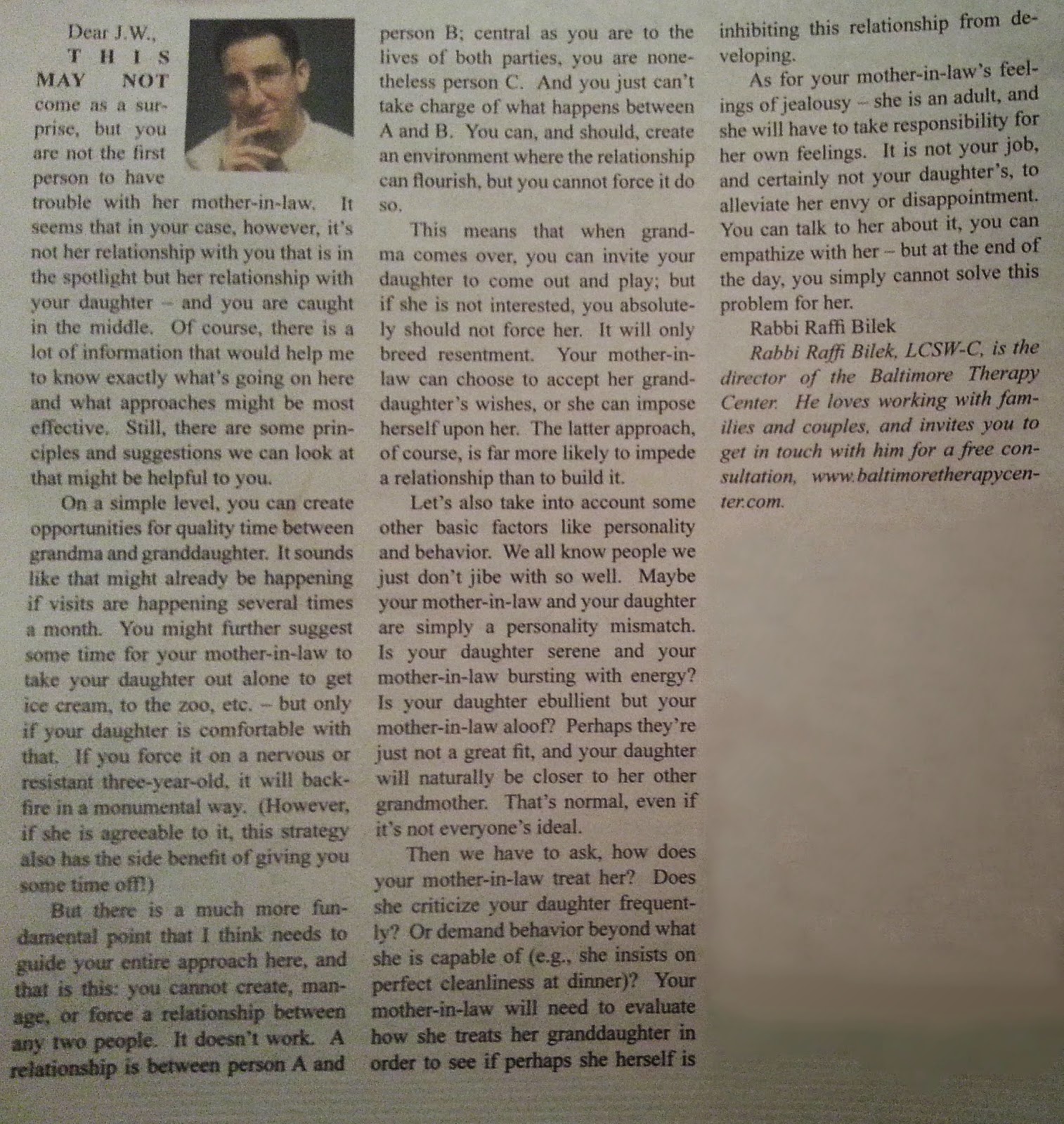
One of the kinds of issues I am frequently called upon to help with involves relationships among parents/in-laws/grandparents.  Here is a column I wrote recently in the Baltimore Jewish Home addressing such an issue.  This doesn't necessarily sound like a candidate for family therapy, but it could certainly help.  These situations can be thorny, no doubt about it.


Sunday, October 5, 2014

Love after Adultery

It is commonly thought that adultery is a certain death blow to a marriage.  After all, what could possibly do more injury to a relationship than an affair?  It strikes us as the worst thing someone could do.  Heck, it even made it into the Ten Commandments!  I once heard a counselor say to me, “I can generally save any marriage, as long as it doesn’t involve adultery.”  So it’s certainly a widespread perception, even among professionals.

The truth is, however, that adultery doesn’t have to mean the end of a marriage.  This is not at all to minimize the severity of the offense; rather, it reflects the genuine Jewish perspective that there is nothing for which a person cannot do teshuva.  As I have pointed out in a previous post, it’s really not the act itself, whatever that was, that is the problem. The problem is that the partner who has been cheated on feels terribly betrayed.  There is pain, anger, loss of trust, jealousy.  But the intensity of these emotions does not have a strong correlation with the seriousness of the act – that is to say, partners of people who have cheated are liable to have severe reactions whether the offense was a full-blown sexual affair or whether it was “just” cybersex (again, see this post).  Some spouses have much more mitigated responses, even in the face of extended, involved extramarital relationships.

This is because, as have I claimed, the offense is not in the act itself but in the emotional import of the act.  The reaction to a broken trust is very dependent on how much trust there was in the first place!  It also depends on many factors within the person and the relationship, such as the spouse’s emotional volatility, past experiences, optimism/pessimism, and more.

That said, all is not lost when a relationship is shattered by the discovery of an affair.  If the violation of trust is the core issue, then trust can also be rebuilt.  This, of course, is not a guarantee.  First and foremost, it depends on the willingness of the betrayed spouse.  Some spouses may be willing to think about repairing the relationship (after a period of grief and anger, most likely).  Others may simply decide to walk away from it (especially if it is a last-straw kind of violation).  Nobody can make that decision except for him/her.  This is an important point to remember for those who have committed the infidelity and who hope or expect that their spouse will “just get over it.”

Repair also depends on the spouse who cheated, primarily in whether he or she will take responsibility for his/her actions.  Those who minimize the offense, blame their spouse, or throw out an apology and expect forgiveness are not in fact in a place to receive it.

It is not an easy path, but it is also not an impossible one.  If you are struggling with a crisis of infidelity in your relationship, I encourage you to reach out to me – I can help you through it, whether or not reconciling is in the cards.

Tuesday, September 23, 2014

Thursday, September 18, 2014

Positive parenting won't make up for yelling, insulting

I thought this was a powerful article about effect we as parents have on our children.  Check it out:

Young adults who had been criticized, insulted or threatened by a parent growing up were more likely to be anxious or depressed, in a new study.

Even when the same or another parent expressed plenty of affection, researchers found the apparent harmful effects of having a verbally aggressive mother or father persisted   . . .
http://news.yahoo.com/positive-parenting-wont-yelling-insulting-212707632.html

Tuesday, September 9, 2014

It's Not You, It's Me

This is not about breaking up, it's about making up (sort of). A novel way to interpret a classically overused line.

Wednesday, September 3, 2014

Does Sexting Count as Cheating?

Many people aren’t sure how to answer this question.  When a married man is sending inappropriate text messages to another woman (or vice versa), does that “count” as an affair?

The answer is really a subjective one.  When a man cheats on his wife, or a woman on her husband, the problem is not so much the act that took place as it is the breach of trust – one of the parties broke the implicit promise made when they established a committed relationship.  Most people understand that a person can be cheating even if there was no sex involved.  If a married man takes a woman out on a romantic date, buys her dinner, and kisses her goodnight, is that cheating?  I think most people would say yes.

But since the core of the issue is the breaking of the agreement (spoken or unspoken) between husband and wife, the question of infidelity depends on what the couple understood that agreement to be.  (Note: this is a good reminder of how important it is to communicate so that both people have the same understanding of what it is they’ve agreed upon!)  Some couples have an open marriage in which outside partners are allowed – hard to call that cheating since both partners have openly okayed it.  On the other hand, I once worked with a client who had an agreement with her boyfriend that they could be involved with others outside the relationship, but only with people of the same gender – i.e., she could date women, but not other men.  Had she gotten into a relationship with another man, that then would have been considered cheating

So what about sexting?  The answer depends on whether the sexter’s significant other considers it a violation of the relationship to exchange sexual messages or dirty pictures to someone else.  I think most people would see it as such, and in the absence of an explicit agreement otherwise, I think the sensible conclusion is that it is indeed an act of infidelity.  Would you be comfortable with your partner doing such things without your knowledge?  Probably not.

When someone suggests that sexting is not the same as adultery because there was no physical contact, or they were not actually with the person, or some other explanation, they are trying to rationalize the problematic behavior.  Cheating hurts because it sends a message to the partner that the cheater can’t be trusted; that the partner is somehow not good enough; that the other man/woman is better/more attractive/more exciting than the partner; and many more hurtful messages as well.  These messages come across loud and clear whether the adulterous act happens in a motel room or on a smartphone.

Thursday, August 14, 2014

Not Your Average Advice Column Response

This provides a little levity in the family therapy field (check out Amy's response). At the same time, it's a bit sad. (This is just the kind of case I help with, if you find yourself in a similar situation...)
Dear Amy: Every fall, my sister, cousins and a cousin’s sister-in-law have a weekend shopping excursion in our home city. We stay in a hotel, treat ourselves, shop for our children and go out for lunches and dinners. It is a great time to reconnect.
I have a sister “Wendy,” who we do not invite. She is offended to the point of tears when she finds we have not invited her...
http://amydickinson.com/post/85115023030/sisterly-exclusion-makes-one-sis-a-horrible-person

Wednesday, August 6, 2014

New book available!

My third children's book is now available on Amazon.com!  Aptly titled "Sisters," it's meant to address some of the challenges (and benefits!) of having an older or younger sister. Sibling rivalry is a fact of life, but I think bringing it out into the open and discussing frankly with children what is hard and what is fun about sibling relationships is a good way to help ease the tensions.

Check it out here!