Showing posts with label parenting. Show all posts

Thursday, March 29, 2018

Freedom for Our Children and Our Children's Children


“If the Holy One, blessed be He, had not taken our ancestors from Egypt, behold we and our children and our children's children would [all still] be enslaved to Pharaoh in Egypt.”

This text from the Haggadah begs the famous question, “Really?” That is to say, ancient Egypt is long defunct.  Had we really not been taken out by G-d at that time, probably we would have eventually gotten out of that jam when Egypt was conquered by the next up-and-coming world power. So what is the Haggadah talking about here? The famous answer is that we are not talking about physical freedom, but about spiritual freedom, which, after all, is what Judaism is all about.  Had we not been saved from Egypt, we would have completely assimilated and lost our Jewish identities, our Jewish selves, our Jewish missions. 

The impact of the environments we live in and of our surrounding cultures cannot be taken lightly.  Though we were nearly lost in Egypt, Jews have remained Jews through the worst physical persecutions.  Jewish identity in America today is more threatened than it was for centuries in Poland under oppressive regimes and crushing poverty, until the Enlightenment opened up new avenues for Jews into European society and assimilation began en masse.

Modern Western culture may share more with ancient Egypt, however, than with the Europe of recent history. The linguistic root of the word “Pharaoh” in Hebrew means “wild, let loose, shameless.” When we say we would still be slaves to Pharaoh, we indeed mean a spiritual slavery, a slavery of our soul to our baser instincts. One can be free to move about as he pleases and still be acting more out of compulsion than contemplation.  If you aren’t sure how to understand this idea, ask someone who’s addicted to drugs, or alcohol, or better yet, internet pornography – they’ll tell you what it’s like to be enslaved to the power of desire.

Our society today aggressively pushes a life of the body over the mind, let alone the soul.  Our girls are taught that their only value is in the shape of their physique, and that only one kind of shape is acceptable.  They are sexualized at younger and younger ages and are being taught how to flaunt that sexuality front and center, rather than channel it for meaningful ends.  Meanwhile, our boys continue to learn that their greatest worth comes from the conquest of women, and society continues to give them a “presidential pardon” when they engage in such conquest by force or coercion.  They are stars when they are celebrities and athletes, and are thus given a pass on all kinds of ignoble behaviors.

This is nothing you don’t already know. But have you stopped to think lately about how you too are a part of this shamelessness? How society has dragged you just a little bit further in than you’d like or care to admit?  Here’s one way I’ve discovered in which I am part of the problem rather than the solution.  Like most everyone else, when I come home to find my daughters dressed for Shabbos, or ready for a wedding, or wearing an outfit I haven’t seen before, what’s the first thing I say? “Ohhh, beautiful! You look so pretty!”  Don’t we all, upon visiting our friends and siblings, greet their daughters by commenting on how nice they look?

Granted, it is a little awkward to suggest opening up with “Ohhh, you are clearly very diligent and analytical!” First impressions inherently do not lend themselves to seeing beneath the surface.  But that doesn’t mean that focusing on the surface is a wise alternative.  If the first thing your children hear from you concerns their appearance, what are they to assume is your priority? Worse, what if you never do comment on their qualities of character or intelligence?

So I’m going to aim for a change. I’m done with being a part of enslaving my girls to the tyranny of cultural pressures.  I want my children to grow up knowing that the most valuable part of themselves is not how they look (and even less how others think they look), that freedom is more about choosing the right values and not the right shoes, and that ultimately their bodies are not what is most valuable about them, but rather merely a vessel to express that which is.


Postscript: Admittedly, alternatives to commenting on our children’s cuteness aren’t so easy to come up with.  Here are some of my ideas. Would love to hear some ideas from you in the comments!
  • “It’s so nice you see you!”
  • “That is a very creative hairdo!”
  • “You look all ready for Shabbos!”
  • “I see you’ve been a big helper by getting yourself dressed!”


Tuesday, November 28, 2017

Families With Special Needs Children Need Maps

Guest post by Dr. Judith Greenberg

If you are a parent of a special needs child, you may feel like you need some help but may not be sure who or what to ask. I always suggest that the best approach is to follow a map of the people you think may really want to help you, such as: your friends and family, pediatrician, psychologist, your shul, Rabbi, your child’s school, specific organizations, and most importantly, your own intuition.

Age and the diagnosis of your child’s special needs run the map that you create. My main recommendation is to get home activities down to a specific set of steps: getting ready for bed, dressing in the morning, doing chores, eating and listening to parents are all survival musts. Having a student behave in school is the next step on this map and the school must work with you to achieve the goals on that map.

Mornings can be very difficult if a child has to make decisions or doesn’t like your choices. Start the night before and let your child make one or two clothing choices. Only one outfit may be worn the next day, the second one is an extra in case of a change in the weather. If bathing is an issue, do that at night too. This leaves a lot less for the morning, but please remember that a half an hour is not the same to your child as it is to you. Children have a different internal clock and time is endless, so you may need to use a timer, or cell phone to remind your son or daughter that only fifteen minutes are left before leaving for the school bus. When it comes to behaviors that you would like to improve, try a sticker reward chart or a computer or video time reward for a day or week of your child controlling a behavior. If you think two behaviors can be worked on, that is fine. However it is probably more effective to work on one first and see what your child can deal with in a week. Study what makes your child happy and then reward with “happy things”. Do not punish as this just makes life harder for a child that is trying to understand what is expected of her. Start off slowly and gradually move up to more expectations.

School needs to be on your map. If you are satisfied with your Yeshiva or public school’s special needs program and your child has an IEP or 504 Plan, be sure to set up a meeting to review the plan before school starts each year as your child’s needs change quickly and it is better to be ready when school starts, but not after issues arise two months later. Schools can’t make you wait for a deadline date, you can have a meeting any time you feel there is a problem or concern. Schools have to accommodate your child and follow through on their promises.

Hold the school to the letter of the law. Whether you chose to enroll you child in a Yeshiva or in a public or private school that has better provisions for him or for her, be sure to attend Open House visits and also ask if you can visit on a regular day to talk with the principal, counselor, service providers, psychologist or any other professionals that pertain to your child. Do not select a school based on just your friend’s opinion, every child is very different. Working with an educational consultant or advocate is also helpful as such professionals attend meetings and visits schools all the time and will know answers to your questions and help you find the best public or private school for your child. A private school must also accept the IEP or 504 Plan but may change as the staff gets to know your child and to make the plan fit their program or even change to a specific Learning Plan that the school follows.

You are never alone because you always have your maps. We live in a time when research organizations are finding so many ways to help families with special needs children and there are groups all across the nation who help families find the help that children need. Join an organization that supports families with special needs. There are many that are tailored specifically to the needs of frum families. There are many special needs support organizations online, or you can check with your Rabbi, school, relatives, educational consultants, and neighbors. Financial planners and attorneys who handle trusts for special needs children and families are specialists in helping parents find help. Help is out there, even on days when you wish you could scream, hide under the bed or just get a massage.

Dr. Judith Greenberg is the director of www.schoolfinders.net and a principal with
www.iser.com, a national learning resource site for kids and teens with special needs

Tuesday, June 27, 2017

Your Kid's End-of-Year Recital

Here's another post from me on Kveller.com which I wrote after reflecting on my kindergartener's brilliantly produced end-of-year production. Writing this was a reminder to me as much as to any of my readers what we're doing when we do this whole parenting thing. Hope it resonates with you too!


This week I attended my 6-year-old daughter’s end-of-the-year kindergarten presentation. Her class was up on stage for maybe 12 minutes. They sang some very elementary songs (no pun intended) and each child had about a two-line speaking part. “Hamilton,” it was not. It was not even a satisfying display of the skills and knowledge I am paying through the nose for my daughter to learn there.
Nonetheless, I feel I got a great deal of value in her having put on this presentation, and in my having attended it . . .


Sunday, January 24, 2016

The Best Gift for Your Children

I've recently been thinking about the adage familiar to many marriage counselors that "The best gift you can give your children is shalom bayis."  There are many reasons this is true - it is neither some crazy therapist thing nor a mystical idea.  Check out a quick run-down I wrote for Aish.com here, or a longer series of posts at my Baltimore Therapy Center blog, starting here.

Monday, July 6, 2015

Why I Let My Daughter Listen to Rap Music

Check out the latest article on Kveller: http://www.kveller.com/why-i-let-my-daughter-listen-to-rap-music/
It's actually not so much about rap and a lot more about the perspectives we bring to parenting. B
ut you probably knew that already.

Saturday, April 18, 2015

Tuesday, March 24, 2015

Saturday, February 28, 2015

The Very Special Gift

Dear Readers,

I am most pleased to announce the publication of my latest book, The Very Special Gift.  It is designed to help parents educate and discuss with their daughters the issue of tznius.  It is targeted to early grade-school-age girls, but it probably has a good degree of flexibility in terms of getting the message across.  I hope that this will be helpful to many people in addressing this vital and challenging subject with your daughters.


If you buy a copy, please do let me know what you think in the comments below!

Saturday, February 14, 2015

We're ALL Exhausted

My recent Kveller article entitled “I’m an Orthodox Jewish Father and I’m Exhausted” got a lot of sympathetic comments from people in the same metaphorical boat of parenthood and exhaustion.  Folks shared with me their low moments, their parenting fails, their misgivings, and so on, often with more than a tinge of shame.  And I responded to them, guess what? You’re just like the rest of us! Thus did I embark upon my second article on the subject, with the intent of reassuring all you struggling parents out there that you’re not the only one.

Really. You’re not the only one.

In fact, I maintain that parents of multiple young children are as a rule overtired, overburdened, and just plain overwhelmed.  I would even say that this is true of all parents of young children, but I’m sure there are some exceptions to the rule and that there’s a handful of you out there who really are sailing effortlessly through the process.

I’m not one of them.

It’s hard, folks.  Look, I’m a marriage and family therapist.  I counsel people on parenting issues, among other things.  I know what I’m doing.  And I’m still tired out by the process, grappling with the challenges, and run ragged by my interminably energetic children.  You are not alone!  Parenting is a tough job for all of us, and nobody’s perfect.  All parents make mistakes.  All parents sometimes lose their cool.  All parents sometimes have thoughts about stuffing those little creatures back where they came from and going back to the easy life.  This is true even of your neighbor whose house looks spotless at all times, who always has a bright smile on her face, and who seems to be way above this kind of problem.  She’s not.  We all try to put on a good face for the outside world, some more successfully than others, but your neighbor has it tough too.  Maybe she has the money to hire a cleaning lady to keep the house perpetually tidy, but she might have a special needs child whose problem can’t be fixed by any amount of money.  Maybe she’s be great at plastering a smile on her face, but it doesn’t mean the she’s feeling any better than you are.  Trust me – she may very well be my client, crying helplessly in my office once a week.

Let’s step back here for a moment and take a broader perspective.  Why are we having so much trouble with just two or three or four kids when our forebears generally had much larger families and apparently did not crumble under the pressure?  I think it is vital to recall just how different times are today from the way things used to be.  Life was much, much harder “back in the day.”  Things we take for granted today could not have even been imagined before 150 years ago or so.  Electricity in every house, air conditioning and heat, running water everywhere, not to mention computers, the internet, and smartphones.  It used to be that you had to work all day every day just to put enough food on the table to survive, and that the majority of the population wasn’t entirely sure they would have it on a regular basis.  It used to be that for most of the year you suffered because it was too cold or too hot, depending on where you lived.  It used to be that people had more kids because they needed them to work on the farm!  And let’s not forget that “family” and “community” were much stronger terms before the world of cars and telecommunication – even your great-grandmother would have been scandalized at the thought of two people trying to raise a couple of kids on their own!

Today everything is designed for you to be comfortable.  Comfort as a goal was unthinkable for most of human history.  Survival was where it was at.  So for us in our coddled and pampered lives to contend with the challenges of childrearing is an entirely different kettle of fish than it was for our ancestors.  Chutzpah from a six-year-old somehow doesn’t register high on the concern scale when you are trying to figure out how to keep enough calories coming in to survive the rest of the winter, when you are running low on firewood, and when you’ve already lost two children in childbirth.

So back to us.  We’re just not used to life being as hard as it once was.  Road bumps that seemed minor back then look like mountains today.  We expect the world to work for us, not against us, and when our children don’t follow suit, we go nuts.  (This also explains why especially in poor areas you can still find parents who have more children than they can count on their fingers and who aren’t tearful puddles of jelly on the floor – they too don’t have the expectation or experience that life should pretty much be easy.)

Life is not going back to the old way anytime soon. The world is a very different place, and it may be that a large family is for most of us no longer a realistic ambition.  That’s okay.  Having children has always been an important Jewish value, but it’s not the only one.  Being real about the modern world and fulfilling our roles within it is a fine and dandy approach; in fact, we can’t really do it any other way.

So don’t fret.  It’s going to be hard.  It’s going to be long.  I hear it’s nice on the other side of the gauntlet, but I haven’t gotten there yet myself to let you know firsthand.  But at the very least, take comfort in the fact that it’s not just you. We’re all struggling – which, let us recall, is not in and of itself a bad thing, especially if you buy into Judaism’s whole personal growth bit – so let’s make peace with the struggle, keep trying to do it better, and support each other as we all hurtle down this crazy road together.

Saturday, November 22, 2014

New Book: "It's Not Fair"

The latest in my children's book series is now available, dealing with the favorite childhood refrain, "it's not fair!"  No doubt this will be a valuable addition to everyone's home library and parenting toolbox!

It's Not Fair

Saturday, November 1, 2014

Getting Your Kids to Eat Their Dinner

Here is another column from the BJH in which I answer the classic question: How do I get my kids to eat their dinner???


Dear BJH,

My kids are really great overall, but the one area that never seems to work out is dinnertime.  They simply don’t want to eat!  It always seems to be a fight getting some food into them.  How can I get them to eat their dinner properly?

Thanks,

GS


Dinnertime is a common flashpoint between parents and kids.  You are not alone!  Let’s take a look at some conceptual points that will help us develop a healthy approach to dinnertime, and then we’ll touch on some practical tips to grease the wheels.

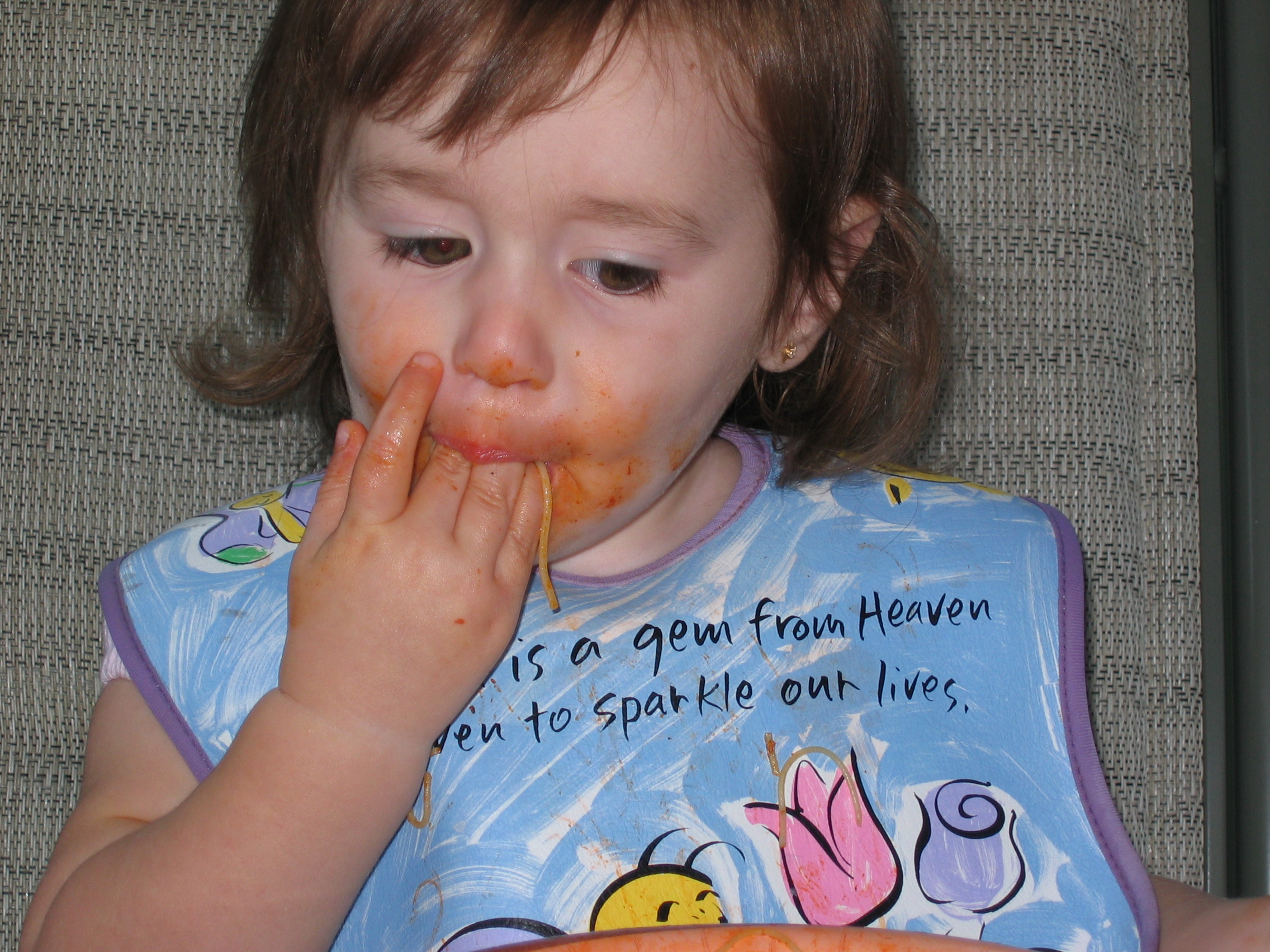
child eating dinnerThe cardinal rule of handling your children’s eating habits is not to make it a power struggle.  If you really really want your kids to eat, and they know it and feel it, they are likely to take the opportunity to assert their independence, as children are wont to do – especially if they are already feeling too controlled or micromanaged at home.  This is normal behavior for a child, not a behavior problem!  The more you try to compel your child to eat, the more resistance you are liable to face.  (This is evident in the classic “Try it – how do you know you don’t like it if you haven’t tried it?” debate.  Have you ever seen a kid finally give in and then say, “Hey, you know what Dad, you’re right!  This is really tasty!”  No, you have not.)

The solution is to not care if they eat. Really.  If you are genuinely concerned about their nutritional levels, take them to the doctor and get a blood test.  If the doctor says your child is healthy, then there is no problem with their food intake.  If they aren’t hungry for dinner, then they aren’t hungry.  (Do you often eat a meal when you aren’t hungry?  Probably not.)  However: you can and should nonetheless establish rules so that they do not drive you crazy later on in the evening.  That means that dinner should be available for a defined period, not whenever they feel like eating.  If they discover that they are in fact hungry just before bedtime, let them have a piece of bread or matzah – something really plain that will sate their hunger.

What happens when you give up your need for them to eat is one of two things: either they stop feeling the need to resist and start eating, or they continue not to eat because they really aren’t hungry.  Fortunately, nature works in your favor on this one, and eventually, they will be hungry enough to eat (trust me on this one). If you keep junk food out of the house as much as possible (or at least inaccessible), and model healthy eating yourself, then when the cravings strike your children will start eating nutritional foods, which keeps you, them, and the doctor happy.

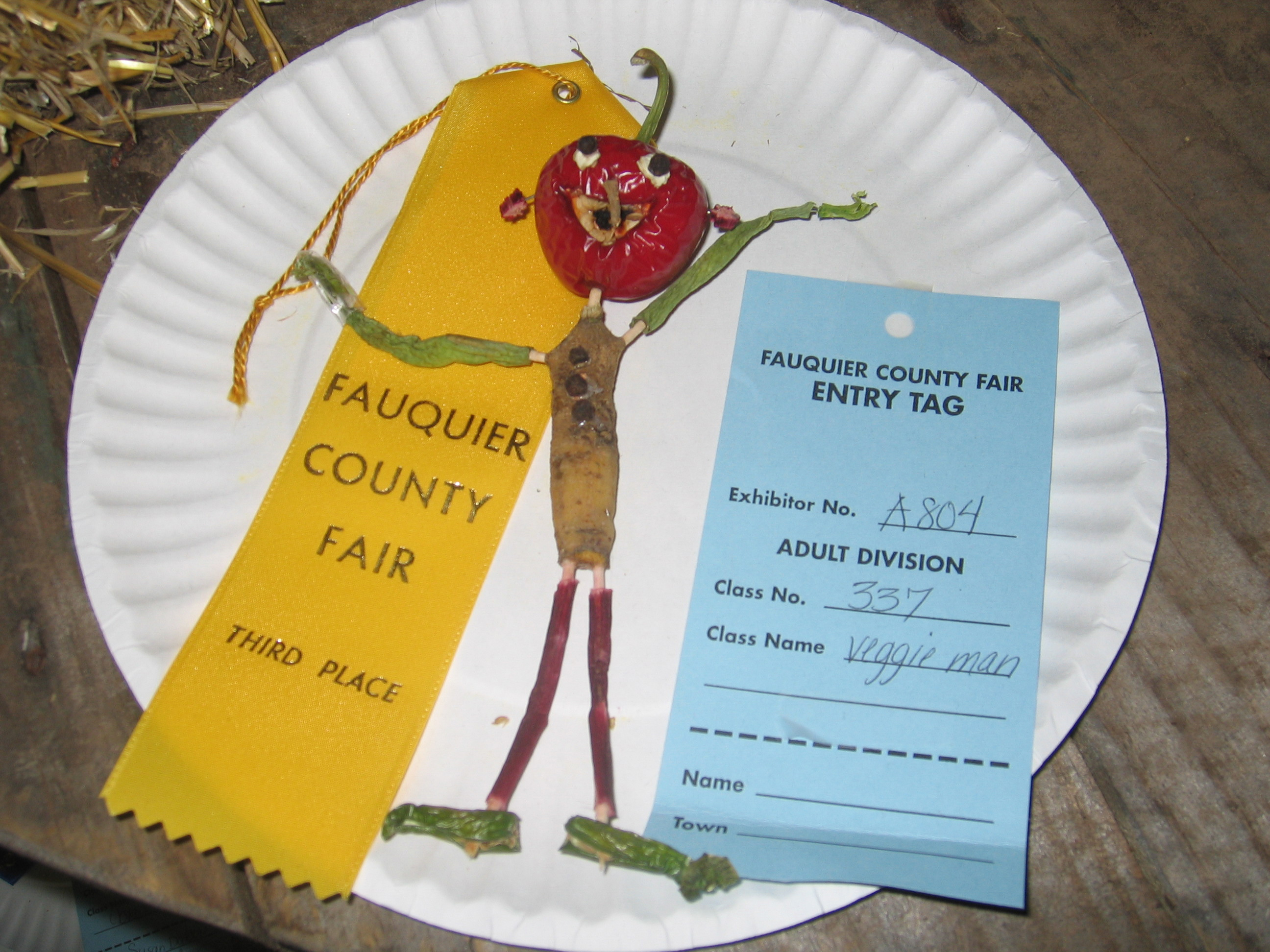
Vegetable ManFinally, some practical points to bear in mind to help ease the situation for fussy eaters and such: first of all, make sure your kids like the food you serve.  This may be obvious, but we sometimes forget that kids in general like simple, whereas we older folks enjoy more complex flavors. Complex doesn’t do it for kids.  They want plain noodles, or maybe noodles with cheese.  A bowl of cottage cheese could be great, with a cucumber stick on the side.  If you are making delicious casseroles for you and your spouse, you may need to be making backup foods for the kids as well.  And yes, they may want to eat the same thing every single day.  Don’t force them not to!  It seems unpalatable to us, but as long as the doc says the kids are healthy, there is absolutely nothing wrong with it.  Their bodies will provide cravings for the right balance – carbs, proteins, etc. – over time (provided that their systems are not awash in sugar).

Lastly, make it fun.  A young child who refused to east his or her veggies moments ago might do a complete 180 once s/he sees the little man with funny hair that you created out of carrots and cukes. Some children like to pretend they are eating fantastic items (magic beans, anyone?) or that they themselves are animals of some kind while they eat. Older children may enjoy being a part of the preparation process.  Creativity is key.


This is not an exhaustive list of ways to better manage dinnertime, but I hope it will spark some ideas for you.  Most importantly, keep in mind the pitfall of the power struggle.  When you let go of your need for the children to behave in a certain way – and this is true in many areas – you may find that they will step up to the responsibility quite on their own.

Saturday, October 18, 2014

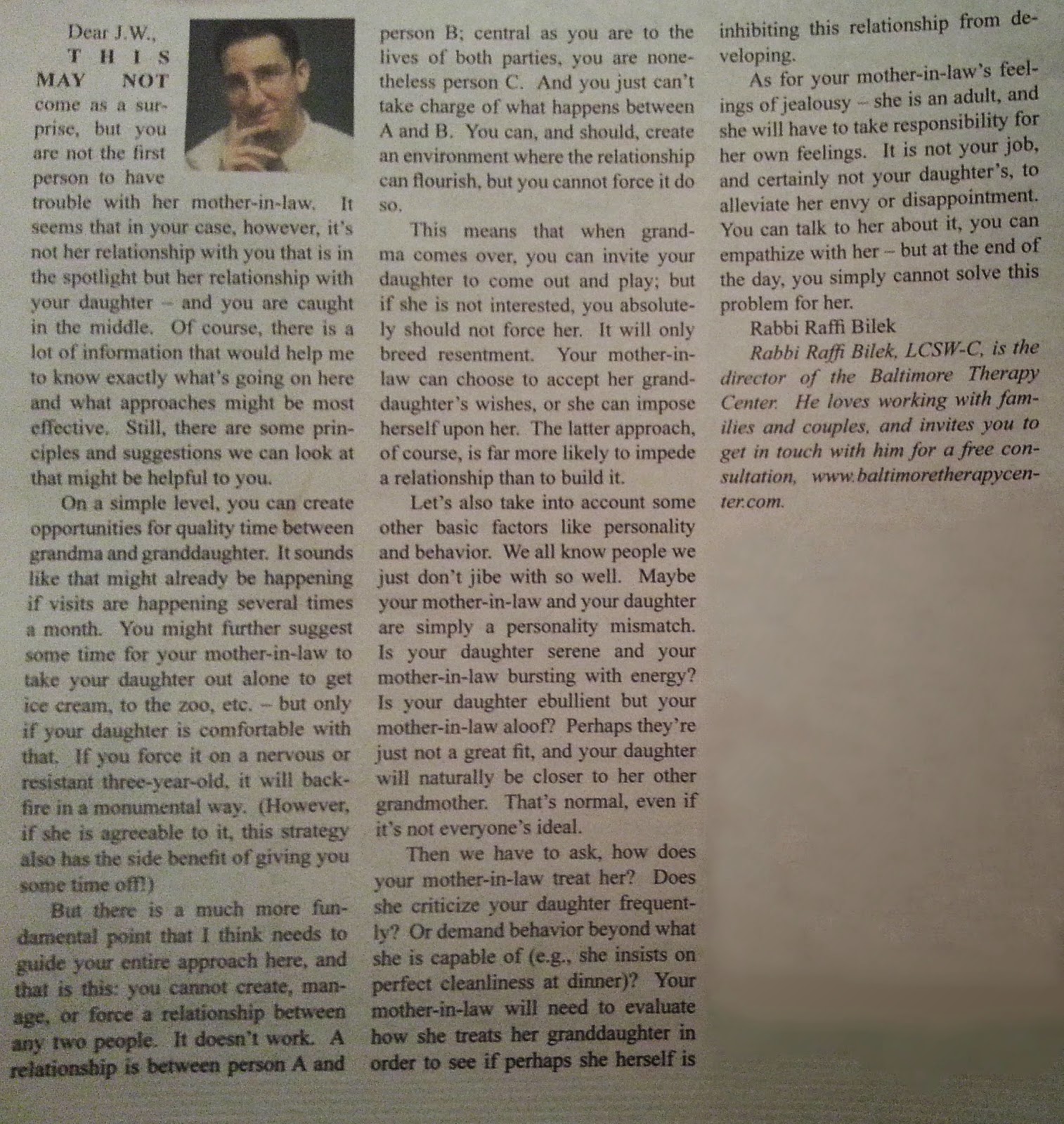
New Article in the Baltimore Jewish Home

One of the kinds of issues I am frequently called upon to help with involves relationships among parents/in-laws/grandparents.  Here is a column I wrote recently in the Baltimore Jewish Home addressing such an issue.  This doesn't necessarily sound like a candidate for family therapy, but it could certainly help.  These situations can be thorny, no doubt about it.


Thursday, September 18, 2014

Positive parenting won't make up for yelling, insulting

I thought this was a powerful article about effect we as parents have on our children.  Check it out:

Young adults who had been criticized, insulted or threatened by a parent growing up were more likely to be anxious or depressed, in a new study.

Even when the same or another parent expressed plenty of affection, researchers found the apparent harmful effects of having a verbally aggressive mother or father persisted   . . .
http://news.yahoo.com/positive-parenting-wont-yelling-insulting-212707632.html

Thursday, August 28, 2014

Kids hear EVERYTHING

Recently, I was sitting at dinner with my wife and kids and discussing the mundane issues of daily life.  At one point my wife mentioned to me something about putting the kids in camp for an extra few days. My six-year-old daughter piped up and cheerfully asked, “Because you don’t want to deal with the kids, right?”

I felt a little bit like dirt.

That is really not how I want my kids to think we look at them.  We so easily overlook how perceptive our kids are from the youngest ages, and how they pick up everything we say, whether we think they are listening or not.  No doubt we have used the phrase “dealing with the kids” numerous times before – look, there’s no question, they can be tough to manage.  They take a ton of energy – not just physically but mentally and emotionally as well.  They suck up time like a miniature screaming snot-nosed black hole.  But we should not be talking about our kids, or even thinking about them, as something we have to “deal with.”  We love them.  We admire them.  We cherish them.  We educate them.  But we do not “deal with” them.  We pour our energies into them with a deep sense of greater purpose as we trying our hardest to build competent, capable, balanced human beings.  It is a privilege and a responsibility.  It is not a chore or a punishment.

You will note here that I am speaking primarily to myself.

But let’s all try to remember it despite the tribulations of childrearing.  And let’s also remember that whatever attitude we choose, our kids will know it.  How do you want your kids to feel growing up? Like a chore?  Or like a precious diamond?  You have a sizeable influence on which way it’s going to go.

Sunday, June 8, 2014

Parenting Help for the Common Parent

The following is a true story.

My three-year-old was having a little attitude attack as my wife and I were trying to coax her into joining me in bed for a nap.  She was loudly insisting that my wife obey her every command.  “DON’T GO THERE! TAKE THIS! DON’T MOVE!” As Mom casually went about her business in spite of these directives, the little one got increasingly upset, and a tantrum started to boil.

What would you have done?

Some people might have tried reasoning with the child, explaining why yelling is bad, or napping is good.  This approach may be successful here and there, but the truth is that three-year-olds don’t have much of a sense of logic, and trying to reason with them often leads to frustration on the part of both parties.  In general I would not recommend reasoning as the method of choice at this age.

Others might simply have gotten angry and yelled, or perhaps spanked.  You can muscle your way into compliance, but it’s not a great long-term strategy.  This is because children become habituated and are no longer deterred by the same levels of force and anger, and also because they age, meaning that after a certain point they’re bigger than you anyway.  Additionally, yelling is usually what you do when you have lost control, and that’s not where you want to be, parenting-wise.

I chose to employ a classic and indispensable parenting technique, namely, distraction.  Read on:

“Mommy,” I said sweetly, did I ever tell you about the time I went to the jungle?” Mommy looked at me skeptically, but played along. “No Daddy, what happened?”  Meanwhile, the revved-up three-year-old was still pointing at my wife a grimace that would curdle milk.  “Well, I saw LIONS in the jungle!  They were big and scary and they had big manes!” Mommy kept it up: “Really, Daddy?” “Oh yes.”  The grimace lightened ever so slightly, almost unnoticeably.  “And you know what else I saw? MONKEYS.  There was a daddy monkey, and a mommy monkey, and a baby monkey!”

In the blink of an eye the grimace was replaced by a look of genuine concern: “Where was the sister monkey?” she questioned urgently, turning towards me.  “Oh, she was out playing. And what do you think she was playing? Come over here and tell me!” I opened my arms and beckoned to her from the comfort of my bed.  And she toddled right into my embrace and lay down as she thought about it.  “Go Fish!” she concluded.  I carried on with my story, naming animals I had seen in the jungle and garnering her input as I went.  (Note: I have never actually been to the jungle, and you don’t have to have been either to make this technique work for you.)
 
Some lessons to learn from this incident: first of all, distraction is a great technique to prevent/avoid tantrums, arguments, and other typical unwanted behaviors your three-year-old has in his/her repertoire.  Second, distraction might mean more than just pointing out the window and saying, “Look! A bird!” – although that is certainly something that works too at times (usually if the situation has not heated up so much yet, or if your young one particularly loves birds, or if there’s actually something really unusual out the window to see, like if the bird in question is, say, an emu).

Finally, you see from this story that you don’t even have to be terribly creative.  The trick is grabbing the child’s interest.  Your child is probably interested in many of the same things mine is – animals, trains, water, and so on.  Cite those things in a story (which obviously does not need to be of literary quality, or even realistic), a question, or a list to shift your child’s focus.  Anyone can pull this off – give it a shot!

Will this technique always work?  Of course not.  It’s just one of many tools you can try.  No tool will work every single time, but as you read above, a good distraction maneuver can be surprisingly effective.

Tuesday, May 27, 2014

My Books Are Back... with a Vengeance


I don't quite know how to explain this, but I just discovered that the two children's books I wrote are now selling for under $4 on Amazon.com.  What a steal! Just wanted to spread the word in case you always wanted a copy but couldn't afford $6...

Wednesday, May 7, 2014

Masturbation

I thought this article was excellent. It discusses the issue of talking about masturbation with Orthodox boys, which I think is tragically shied away from for obvious reasons, leaving our youth to struggle with it in silence.  As you are probably aware by now, I am not a fan of the head-in-the-sand approach.

http://blogs.forward.com/sisterhood-blog/194864/why-rabbis-must-talk-to-orthodox-boys-about-mastur/