If you are not suffering from depression, this video will give you a better idea of what it's like to go through it. This can be especially helpful for friends and family of people with depression
Saturday, October 25, 2014
A Dog Named Depression
This short video offers a fantastic perspective on what it's like to be depressed. If you think you might have depression, check this out, and recognize that you are not alone. You can reach out for help, and things can get better.
If you are not suffering from depression, this video will give you a better idea of what it's like to go through it. This can be especially helpful for friends and family of people with depression
If you are not suffering from depression, this video will give you a better idea of what it's like to go through it. This can be especially helpful for friends and family of people with depression


Saturday, October 18, 2014
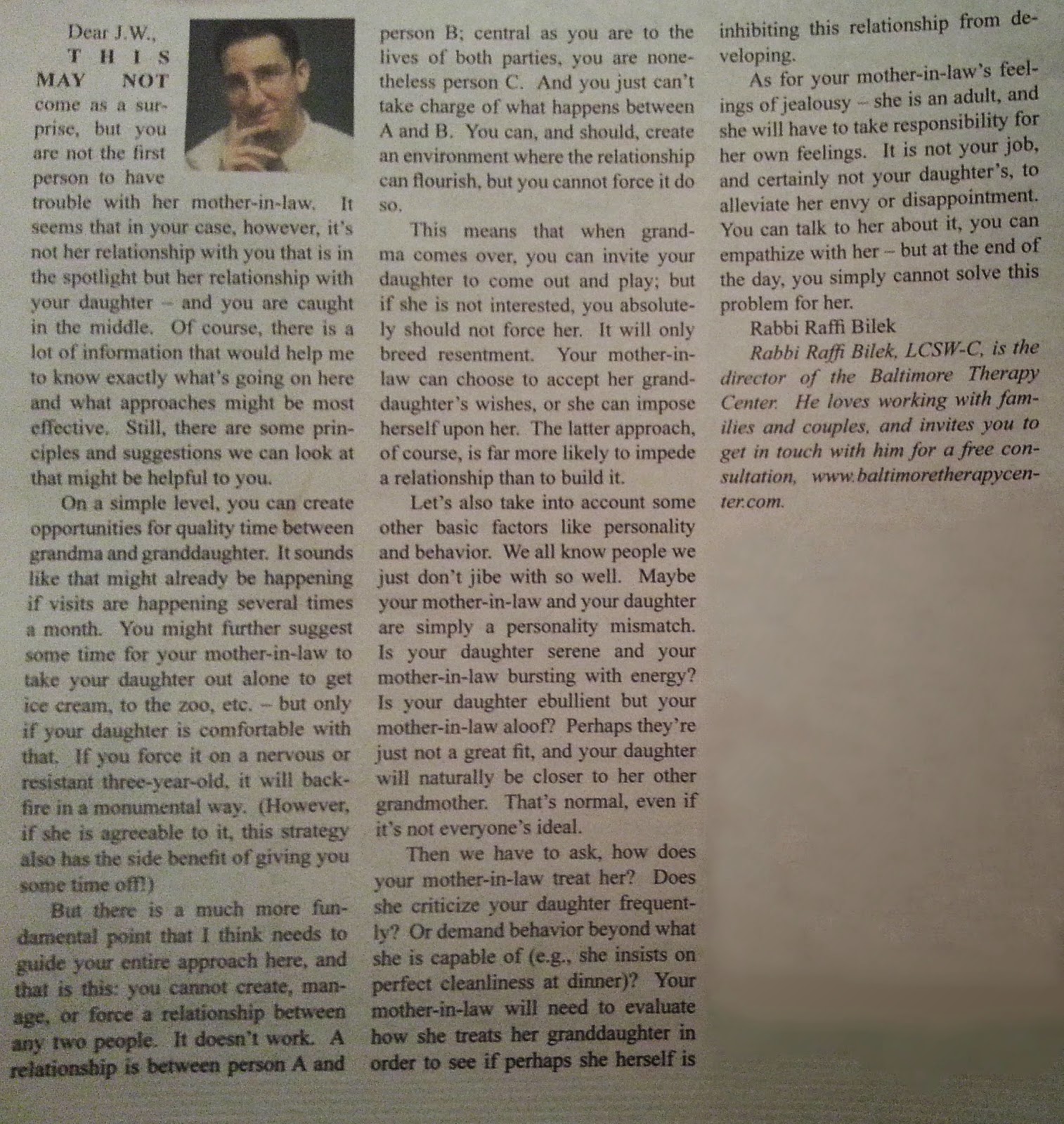
New Article in the Baltimore Jewish Home
One of the kinds of issues I am frequently called upon to help with involves relationships among parents/in-laws/grandparents. Here is a column I wrote recently in the Baltimore Jewish Home addressing such an issue. This doesn't necessarily sound like a candidate for family therapy, but it could certainly help. These situations can be thorny, no doubt about it.

Sunday, October 5, 2014
Love after Adultery
It is commonly thought that adultery is a certain death blow
to a marriage. After all, what could
possibly do more injury to a relationship than an affair? It strikes us as the worst thing someone could
do. Heck, it even made it into the Ten
Commandments! I once heard a counselor
say to me, “I can generally save any marriage, as long as it doesn’t involve
adultery.” So it’s certainly a
widespread perception, even among professionals.
 That said, all is not lost when a relationship is shattered
by the discovery of an affair. If the
violation of trust is the core issue, then trust can also be rebuilt. This, of course, is not a guarantee. First and foremost, it depends on the willingness
of the betrayed spouse. Some spouses may be
willing to think about repairing the relationship (after a period of grief and
anger, most likely). Others may simply
decide to walk away from it (especially if it is a last-straw kind of violation). Nobody can make that decision except for
him/her. This is an important point to remember for those who have committed
the infidelity and who hope or expect that their spouse will “just get over it.”
That said, all is not lost when a relationship is shattered
by the discovery of an affair. If the
violation of trust is the core issue, then trust can also be rebuilt. This, of course, is not a guarantee. First and foremost, it depends on the willingness
of the betrayed spouse. Some spouses may be
willing to think about repairing the relationship (after a period of grief and
anger, most likely). Others may simply
decide to walk away from it (especially if it is a last-straw kind of violation). Nobody can make that decision except for
him/her. This is an important point to remember for those who have committed
the infidelity and who hope or expect that their spouse will “just get over it.”
It is not an easy path, but it is also not an impossible one. If you are struggling with a crisis of infidelity in your relationship, I encourage you to reach out to me – I can help you through it, whether or not reconciling is in the cards.
The truth is, however, that adultery doesn’t have to mean
the end of a marriage. This is not at
all to minimize the severity of the offense; rather, it reflects the genuine
Jewish perspective that there is nothing for which a person cannot do teshuva. As I have pointed out in a previous post, it’s
really not the act itself, whatever that was, that is the problem. The problem
is that the partner who has been cheated on feels terribly betrayed. There is pain, anger, loss of trust,
jealousy. But the intensity of these
emotions does not have a strong correlation with the seriousness of the act –
that is to say, partners of people who have cheated are liable to have severe
reactions whether the offense was a full-blown sexual affair or whether it was “just”
cybersex (again, see this post). Some
spouses have much more mitigated responses, even in the face of extended,
involved extramarital relationships.
This is because, as have I claimed, the offense is not in the
act itself but in the emotional import of the act. The reaction to a broken trust is very
dependent on how much trust there was in the first place! It also depends on many factors within the
person and the relationship, such as the spouse’s emotional volatility, past
experiences, optimism/pessimism, and more.
That said, all is not lost when a relationship is shattered
by the discovery of an affair. If the
violation of trust is the core issue, then trust can also be rebuilt. This, of course, is not a guarantee. First and foremost, it depends on the willingness
of the betrayed spouse. Some spouses may be
willing to think about repairing the relationship (after a period of grief and
anger, most likely). Others may simply
decide to walk away from it (especially if it is a last-straw kind of violation). Nobody can make that decision except for
him/her. This is an important point to remember for those who have committed
the infidelity and who hope or expect that their spouse will “just get over it.”
Repair also depends on the spouse who cheated, primarily in
whether he or she will take responsibility for his/her actions. Those who minimize the offense, blame their
spouse, or throw out an apology and expect forgiveness are not in fact in a
place to receive it.
It is not an easy path, but it is also not an impossible one. If you are struggling with a crisis of infidelity in your relationship, I encourage you to reach out to me – I can help you through it, whether or not reconciling is in the cards.
Tuesday, September 23, 2014
Supporting Others
 I thought this article about supporting the people in your life was excellently presented.
http://www.aish.com/sp/so/99754929.html
Thursday, September 18, 2014
Positive parenting won't make up for yelling, insulting
I thought this was a powerful article about effect we as parents have on our children. Check it out:
Young adults who had been criticized, insulted or threatened by a parent growing up were more likely to be anxious or depressed, in a new study.
http://news.yahoo.com/positive-parenting-wont-yelling-insulting-212707632.htmlEven when the same or another parent expressed plenty of affection, researchers found the apparent harmful effects of having a verbally aggressive mother or father persisted . . .
Tuesday, September 9, 2014
It's Not You, It's Me
This is not about breaking up, it's about making up (sort of). A novel way to interpret a classically overused line.
Wednesday, September 3, 2014
Does Sexting Count as Cheating?
Many people aren’t sure how to answer this question.
When a married man is sending inappropriate text messages to another woman (or
vice versa), does that “count” as an affair?
 So what about sexting? The answer depends on whether
the sexter’s significant other considers it a violation of the relationship to
exchange sexual messages or dirty pictures to someone else. I think most
people would see it as such, and in the absence of an explicit agreement
otherwise, I think the sensible conclusion is that it is indeed an act of
infidelity. Would you be comfortable with your partner doing such
things without your knowledge? Probably not.
So what about sexting? The answer depends on whether
the sexter’s significant other considers it a violation of the relationship to
exchange sexual messages or dirty pictures to someone else. I think most
people would see it as such, and in the absence of an explicit agreement
otherwise, I think the sensible conclusion is that it is indeed an act of
infidelity. Would you be comfortable with your partner doing such
things without your knowledge? Probably not.
The answer is really a subjective one. When a man cheats
on his wife, or a woman on her husband, the problem is not so much the act that
took place as it is the breach of trust – one of the parties broke the implicit
promise made when they established a committed relationship. Most people
understand that a person can be cheating even if there was no sex
involved. If a married man takes a woman out on a romantic date, buys her
dinner, and kisses her goodnight, is that cheating? I think most people
would say yes.
But since the core of the issue is the breaking of the
agreement (spoken or unspoken) between husband and wife, the question of
infidelity depends on what the couple understood that agreement to be. (Note: this is a good reminder of how
important it is to communicate so that both people have the same understanding
of what it is they’ve agreed upon!) Some couples have an open marriage in
which outside partners are allowed – hard to call that cheating since both partners
have openly okayed it. On the other hand, I once worked with a client who
had an agreement with her boyfriend that they could be involved with others
outside the relationship, but only with people of the same gender – i.e., she could date women, but
not other men. Had she gotten into a relationship with another man, that then
would have been considered cheating
So what about sexting? The answer depends on whether
the sexter’s significant other considers it a violation of the relationship to
exchange sexual messages or dirty pictures to someone else. I think most
people would see it as such, and in the absence of an explicit agreement
otherwise, I think the sensible conclusion is that it is indeed an act of
infidelity. Would you be comfortable with your partner doing such
things without your knowledge? Probably not.
When someone suggests that sexting is not the same as
adultery because there was no physical contact, or they were not actually with
the person, or some other explanation, they are trying to rationalize the
problematic behavior. Cheating hurts because it sends a message to the partner
that the cheater can’t be trusted; that the partner is somehow not good enough;
that the other man/woman is better/more attractive/more exciting than the partner;
and many more hurtful messages as well.
These messages come across loud and clear whether the adulterous act
happens in a motel room or on a smartphone.
Thursday, August 28, 2014
Kids hear EVERYTHING
 Recently, I was sitting at dinner with my wife and kids and
discussing the mundane issues of daily life.
At one point my wife mentioned to me something about putting the kids in
camp for an extra few days. My six-year-old daughter piped up and cheerfully
asked, “Because you don’t want to deal with the kids, right?”
Recently, I was sitting at dinner with my wife and kids and
discussing the mundane issues of daily life.
At one point my wife mentioned to me something about putting the kids in
camp for an extra few days. My six-year-old daughter piped up and cheerfully
asked, “Because you don’t want to deal with the kids, right?”
I felt a little bit like dirt.
That is really not how I want my kids to think we look at
them. We so easily overlook how
perceptive our kids are from the youngest ages, and how they pick up everything
we say, whether we think they are listening or not. No doubt we have used the phrase “dealing with
the kids” numerous times before – look, there’s no question, they can be tough
to manage. They take a ton of energy –
not just physically but mentally and emotionally as well. They suck up time like a miniature screaming
snot-nosed black hole. But we should not
be talking about our kids, or even thinking about them, as something we have to
“deal with.” We love them. We admire them. We cherish them. We educate them. But we do not “deal with” them. We pour our energies into them with a deep
sense of greater purpose as we trying our hardest to build competent, capable, balanced
human beings. It is a privilege and a
responsibility. It is not a chore or a
punishment.
You will note here that I am speaking primarily to myself.
But let’s all try to remember it despite the tribulations of
childrearing. And let’s also remember
that whatever attitude we choose, our kids will know it. How do you want your kids to feel growing up? Like a chore? Or like a precious diamond? You have a sizeable influence on which way it’s
going to go.
Monday, August 18, 2014
New website!
The Baltimore Therapy Center is now open for business! Check out our website at www.baltimoretherapycenter.com - and tell your friends! We specialize in relationship issues of all kinds, including marital and premarital counseling, dealing with parents, problems with children, and adoption issues.

Thursday, August 14, 2014
Not Your Average Advice Column Response
This provides a little levity in the family therapy field (check out Amy's response).
At the same time, it's a bit sad.
(This is just the kind of case I help with, if you find yourself in a similar situation...)

Dear Amy: Every fall, my sister, cousins and a cousin’s sister-in-law have a weekend shopping excursion in our home city. We stay in a hotel, treat ourselves, shop for our children and go out for lunches and dinners. It is a great time to reconnect.

I have a sister “Wendy,” who we do not invite. She is offended to the point of tears when she finds we have not invited her...http://amydickinson.com/post/85115023030/sisterly-exclusion-makes-one-sis-a-horrible-person
Wednesday, August 6, 2014
New book available!

Check it out here!
Monday, July 21, 2014
Four Ways to Fight with Your Spouse
Here's an article I found worth reading, about how to manage fights in your relationship without letting them destroy it.
4 Ways to Fight with Your Spouse without Destroying your Marriage
4 Ways to Fight with Your Spouse without Destroying your Marriage

Thursday, July 10, 2014
I Follow My Own Marriage Advice - part II
How did I do it? How did I get mad at my wife (see previous post) and get an apology in return instead of a retaliation? Let’s take a look at why people often offer resistance rather than a deserved “sorry.”
When we apologize for something, we are admitting that we are wrong. We made a mistake. It is a blow to our ego. Nobody likes to feel dumb, stupid, inferior, etc. Of course, intellectually we all know that making a mistake doesn’t make us bad or stupid – everyone makes mistakes! But emotionally we are not always living with that reality. Making a mistake can feel really crummy. And when someone else is witness to our mistake, we are embarrassed.
So we try to puff ourselves up, put on a strong appearance, lest we look and feel weak. Hence, if you want to avoid a defensive reaction, you have to make your partner feel strong in general so that s/he will not feel weak when s/he makes mistakes. (You will note here that the answer to my opening question turns out not to be a “technique” or a clever turn of phrase – it is an answer that encompasses the whole relationship. Shoulda seen that coming, right?) So how do you make your partner feel strong? S/he must know and feel that you respect him/her. This means that you have to tell him/her that – through compliments, praise, and encouragement. (These are subjects for a post in their own right.) You must respect and convey respect to your partner. Because my wife knows I respect her, she does not feel lowly when she makes a mistake. And she knows that I will love and respect her regardless of this mistake.
Respecting your partner also means accepting that s/he will, of course, mess up from time to time. That means that once a problem is resolved, you let it go, because s/he is just another human being who makes mistakes. My wife knows that I am not going bring this episode up over and over again in the future (except to blog about it to a public audience of friends and strangers); therefore she did not feel she had to neutralize a potential weapon in my hands by proving that she was in fact not wrong. If you are going to refer back to this mistake over and over in the future (“Oh yeah, well what about that time you did XYZ!” “Sorry, I’m not doing [blank] for you, not after you did XYZ…”), you can bet that your significant other is going to try to wiggle out of accepting responsibility for the error, lest s/he have to face these kind of consequences.
And now we come to some of the more situation-specific pointers, comments about how you say it when the issue comes up. Number one, you can’t be wildly emotional or out of control when you tell your partner about the issue. If you do, that can be scary, thus eliciting a retreat; it can be perceived as an attack, thus provoking a counter-attack; and it can also simply engender a parallel response from him/her (in accordance with the function of mirror neurons, which, in brief, make it that people are likely to reflect back to someone the emotion they are being shown - as Shlomo HaMelech says, kamayim hapanim lapanim, ken lev ha'adam la'adam).
Number two, do not insult or put your partner down. Again, you are asking for a protected response if you do, and that is not your goal. (If your goal is to hurt your spouse’s feelings, then go right ahead. But then it is probably the case that you are juvenile, or else sadistic.)
Number three, you must address the behavior, not the person. “I am disappointed that you forgot [blank],” not “You’re an idiot.” In my case, I said to my wife about what had happened, “this was poor judgment,” not “you have poor judgment.” See the difference?
There’s a lot more to say on this, and I’m sure we’ll come back to the topic in the future. But here we have laid out some of the underlying ideas that help a couple to weather each other’s mistakes and even to get angry about them, as well as some of the specifics of effectively expressing that anger.
When we apologize for something, we are admitting that we are wrong. We made a mistake. It is a blow to our ego. Nobody likes to feel dumb, stupid, inferior, etc. Of course, intellectually we all know that making a mistake doesn’t make us bad or stupid – everyone makes mistakes! But emotionally we are not always living with that reality. Making a mistake can feel really crummy. And when someone else is witness to our mistake, we are embarrassed.
So we try to puff ourselves up, put on a strong appearance, lest we look and feel weak. Hence, if you want to avoid a defensive reaction, you have to make your partner feel strong in general so that s/he will not feel weak when s/he makes mistakes. (You will note here that the answer to my opening question turns out not to be a “technique” or a clever turn of phrase – it is an answer that encompasses the whole relationship. Shoulda seen that coming, right?) So how do you make your partner feel strong? S/he must know and feel that you respect him/her. This means that you have to tell him/her that – through compliments, praise, and encouragement. (These are subjects for a post in their own right.) You must respect and convey respect to your partner. Because my wife knows I respect her, she does not feel lowly when she makes a mistake. And she knows that I will love and respect her regardless of this mistake.
Respecting your partner also means accepting that s/he will, of course, mess up from time to time. That means that once a problem is resolved, you let it go, because s/he is just another human being who makes mistakes. My wife knows that I am not going bring this episode up over and over again in the future (except to blog about it to a public audience of friends and strangers); therefore she did not feel she had to neutralize a potential weapon in my hands by proving that she was in fact not wrong. If you are going to refer back to this mistake over and over in the future (“Oh yeah, well what about that time you did XYZ!” “Sorry, I’m not doing [blank] for you, not after you did XYZ…”), you can bet that your significant other is going to try to wiggle out of accepting responsibility for the error, lest s/he have to face these kind of consequences.
And now we come to some of the more situation-specific pointers, comments about how you say it when the issue comes up. Number one, you can’t be wildly emotional or out of control when you tell your partner about the issue. If you do, that can be scary, thus eliciting a retreat; it can be perceived as an attack, thus provoking a counter-attack; and it can also simply engender a parallel response from him/her (in accordance with the function of mirror neurons, which, in brief, make it that people are likely to reflect back to someone the emotion they are being shown - as Shlomo HaMelech says, kamayim hapanim lapanim, ken lev ha'adam la'adam).
Number two, do not insult or put your partner down. Again, you are asking for a protected response if you do, and that is not your goal. (If your goal is to hurt your spouse’s feelings, then go right ahead. But then it is probably the case that you are juvenile, or else sadistic.)
Number three, you must address the behavior, not the person. “I am disappointed that you forgot [blank],” not “You’re an idiot.” In my case, I said to my wife about what had happened, “this was poor judgment,” not “you have poor judgment.” See the difference?
There’s a lot more to say on this, and I’m sure we’ll come back to the topic in the future. But here we have laid out some of the underlying ideas that help a couple to weather each other’s mistakes and even to get angry about them, as well as some of the specifics of effectively expressing that anger.
Sunday, June 29, 2014
I Follow My Own Marriage Advice
One of the points I often make when talking about marriage
is the critical importance of not talking about something that made you madright after it happens. You cannot
possibly accomplish anything productive at that moment and you can only make
things worse. So let me tell you a story.
 So I do practice what I preach. And I continue to preach it, because it works. This incident could have caused a huge
ruckus, a lot of anguish, a distancing in the relationship – but instead, it
passed over uneventfully. As a matter of fact, it even brought us closer,
because it provided yet another demonstration that we can share our anger with
each other, that we can make mistakes, and that whatever the problem, we have a
way to address and resolve it.
So I do practice what I preach. And I continue to preach it, because it works. This incident could have caused a huge
ruckus, a lot of anguish, a distancing in the relationship – but instead, it
passed over uneventfully. As a matter of fact, it even brought us closer,
because it provided yet another demonstration that we can share our anger with
each other, that we can make mistakes, and that whatever the problem, we have a
way to address and resolve it.
A few days ago, my wife did something that absolutely
infuriated me. I was totally
incensed. I couldn’t believe she had had
the poor judgment to do what she did. When
the actual incident occurred, she wasn’t there – she had set things in motion
from elsewhere – so right after it happened I started thinking of all the
angry, nasty things I wanted to say and/or do.
And I didn’t move. I allowed
myself to spend some time fuming and stewing, but I firmly told myself I would
not actually say anything until the next day.
Many ideas came into my mind. Sharp, angry rants, clever
passive-aggressive maneuvers, or plain old blowing my top. But I didn’t move. I didn’t open my mouth. I
told myself I could better deal with it the next day.
I waited all day the next day without whispering a word
about it. Eventually, that evening, we
had a calm moment in the car where we could speak. In a very calm voice, I told
her what had happened that upset me and that I was very angry with her for causing
it. I expressed shock at her lack of judgment.
She acknowledged her mistake. She accepted my anger. She apologized. And then we were done. I no longer needed to get back at her, or yell,
or blow off steam. It was okay. She got it.
So I do practice what I preach. And I continue to preach it, because it works. This incident could have caused a huge
ruckus, a lot of anguish, a distancing in the relationship – but instead, it
passed over uneventfully. As a matter of fact, it even brought us closer,
because it provided yet another demonstration that we can share our anger with
each other, that we can make mistakes, and that whatever the problem, we have a
way to address and resolve it.
And you can learn to do it too. Step one: don’t talk about something
that made you mad right after it happens!
Postscript: I wonder if many readers are thinking, “Well,
that’s all well and good, but the problem is that my spouse would never just
apologize. S/he always has to argue/be defensive/get mad/etc.” In the next post I hope to write a little bit
about how to make your relationship a place where that doesn’t have to happen, and
where both parties can feel safe both expressing anger and offering an apology.
Thursday, June 19, 2014
FrumCounselor has moved to Baltimore!
I have left New Jersey for the Baltimore area. I am still seeing clients around the world on Skype, but in-person meetings are now in Baltimore. Hope to see you soon!
Sunday, June 8, 2014
Parenting Help for the Common Parent
The following is a true story.
 My three-year-old was having a little attitude attack as my
wife and I were trying to coax her into joining me in bed for a nap. She was loudly insisting that my wife obey
her every command. “DON’T GO THERE! TAKE
THIS! DON’T MOVE!” As Mom casually went about her business in spite of these
directives, the little one got increasingly upset, and a tantrum started to
boil.
My three-year-old was having a little attitude attack as my
wife and I were trying to coax her into joining me in bed for a nap. She was loudly insisting that my wife obey
her every command. “DON’T GO THERE! TAKE
THIS! DON’T MOVE!” As Mom casually went about her business in spite of these
directives, the little one got increasingly upset, and a tantrum started to
boil.
My three-year-old was having a little attitude attack as my
wife and I were trying to coax her into joining me in bed for a nap. She was loudly insisting that my wife obey
her every command. “DON’T GO THERE! TAKE
THIS! DON’T MOVE!” As Mom casually went about her business in spite of these
directives, the little one got increasingly upset, and a tantrum started to
boil.
What would you have done?
Some people might have tried reasoning with the child,
explaining why yelling is bad, or napping is good. This approach may be successful here and there,
but the truth is that three-year-olds don’t have much of a sense of logic, and trying
to reason with them often leads to frustration on the part of both parties. In general I would not recommend reasoning as the method of
choice at this age.
Others might simply have gotten angry and yelled, or perhaps
spanked. You can muscle your way into
compliance, but it’s not a great long-term strategy. This is because children become habituated
and are no longer deterred by the same levels of force and anger, and also because
they age, meaning that after a certain point they’re bigger than you anyway. Additionally, yelling is usually what you do
when you have lost control, and that’s not where you want to be,
parenting-wise.
I chose to employ a classic and indispensable parenting technique,
namely, distraction. Read on:
“Mommy,” I said sweetly, did I ever tell you about the time
I went to the jungle?” Mommy looked at me skeptically, but played along. “No
Daddy, what happened?” Meanwhile, the
revved-up three-year-old was still pointing at my wife a grimace that would curdle
milk. “Well, I saw LIONS in the
jungle! They were big and scary and they
had big manes!” Mommy kept it up: “Really, Daddy?” “Oh yes.” The grimace lightened ever so slightly,
almost unnoticeably. “And you know what
else I saw? MONKEYS. There was a daddy
monkey, and a mommy monkey, and a baby monkey!”
In the blink of an eye the grimace was replaced by a look of
genuine concern: “Where was the sister monkey?” she questioned urgently,
turning towards me. “Oh, she was out
playing. And what do you think she was playing? Come over here and tell me!” I opened
my arms and beckoned to her from the comfort of my bed. And she toddled right into my embrace and lay
down as she thought about it. “Go Fish!”
she concluded. I carried on with my
story, naming animals I had seen in the jungle and garnering her input as I
went. (Note: I have never actually been
to the jungle, and you don’t have to have been either to make this technique work
for you.)
Some lessons to learn from this incident: first of all,
distraction is a great technique to prevent/avoid tantrums, arguments, and other
typical unwanted behaviors your three-year-old has in his/her repertoire. Second, distraction might mean more than just
pointing out the window and saying, “Look! A bird!” – although that is
certainly something that works too at times (usually if the situation has not
heated up so much yet, or if your young one particularly loves birds, or if
there’s actually something really unusual out the window to see, like if the
bird in question is, say, an emu).
Finally, you see from this story that you don’t even have to
be terribly creative. The trick is
grabbing the child’s interest. Your
child is probably interested in many of the same things mine is – animals,
trains, water, and so on. Cite those
things in a story (which obviously does not need to be of literary quality, or even
realistic), a question, or a list to shift your child’s focus. Anyone can pull this off – give it a shot!
Will this technique always work? Of course not. It’s just one of many tools you can try. No tool will work every single time, but as
you read above, a good distraction maneuver can be surprisingly effective.
Tuesday, May 27, 2014
My Books Are Back... with a Vengeance


I don't quite know how to explain this, but I just discovered that the two children's books I wrote are now selling for under $4 on Amazon.com. What a steal! Just wanted to spread the word in case you always wanted a copy but couldn't afford $6...
Wednesday, May 14, 2014
Ten Tips for Raising Sexually Healthy Orthodox Daughters
And here's another article sent to me by a friend that address the women's side of sex ed in the Orthodox community. Also well stated.

http://blogs.timesofisrael.com/10-tips-to-raising-sexually-healthy-orthodox-daughters/
Wednesday, May 7, 2014
Masturbation
I thought this article was excellent. It discusses the issue of talking about masturbation with Orthodox boys, which I think is tragically shied away from for obvious reasons, leaving our youth to struggle with it in silence. As you are probably aware by now, I am not a fan of the head-in-the-sand approach.
 http://blogs.forward.com/sisterhood-blog/194864/why-rabbis-must-talk-to-orthodox-boys-about-mastur/
http://blogs.forward.com/sisterhood-blog/194864/why-rabbis-must-talk-to-orthodox-boys-about-mastur/
Thursday, May 1, 2014
Happiness 101
I thought this video had a number of very helpful ideas. Tal Ben-Shachar is one of the leading figures in Positive Psychology today (and, interestingly enough, he's Israeli).
Subscribe to:
Posts (Atom)